9–16. Divergence Test Use the Divergence Test to determine whether the following series diverge or state that the test is inconclusive. ∑ (k = 2 to ∞) k / ln k
Verified step by step guidance
1
Identify the general term of the series: \(a_k = \frac{k}{\ln k}\) for \(k \geq 2\).
Recall the Divergence Test (also known as the Test for Divergence): if \(\lim_{k \to \infty} a_k \neq 0\), then the series \(\sum a_k\) diverges.
Compute the limit of the general term as \(k\) approaches infinity: \(\lim_{k \to \infty} \frac{k}{\ln k}\).
Analyze the behavior of the limit: since \(k\) grows faster than \(\ln k\), the fraction \(\frac{k}{\ln k}\) grows without bound, so the limit does not approach zero.
Conclude that by the Divergence Test, since the limit of \(a_k\) is not zero, the series \(\sum_{k=2}^\infty \frac{k}{\ln k}\) diverges.
Verified video answer for a similar problem:
This video solution was recommended by our tutors as helpful for the problem above
Video duration:
2m
Play a video:
0 Comments
Key Concepts
Here are the essential concepts you must grasp in order to answer the question correctly.
Divergence Test
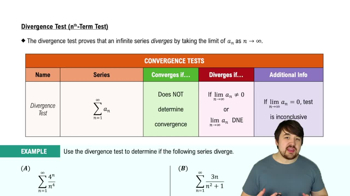
The Divergence Test states that if the limit of the terms of a series does not approach zero as k approaches infinity, then the series diverges. It is a quick way to check divergence but cannot confirm convergence if the limit is zero.
Analyzing the behavior of the general term k / ln(k) as k approaches infinity helps determine if the terms approach zero. Since ln(k) grows slower than k, the term k / ln(k) tends to infinity, indicating the terms do not approach zero.
An infinite series converges only if the sum of its terms approaches a finite limit. If the terms do not approach zero, the series cannot converge. Understanding this principle is essential to apply tests like the Divergence Test correctly.