13–52. Limits of sequences Find the limit of the following sequences or determine that the sequence diverges.
{(n + 1)!⁄n!}
Verified step by step guidance
1
Identify the given sequence: \(a_n = \frac{(n+1)!}{n!}\).
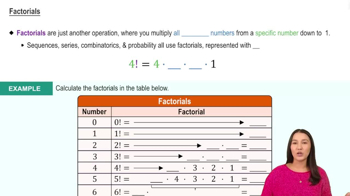
Recall the definition of factorial: \(n! = n \times (n-1) \times (n-2) \times \cdots \times 1\).
Simplify the expression by canceling common factorial terms: \(\frac{(n+1)!}{n!} = \frac{(n+1) \times n!}{n!} = n+1\).
Analyze the simplified sequence \(a_n = n+1\) as \(n\) approaches infinity.
Conclude whether the sequence converges or diverges based on the behavior of \(n+1\) as \(n \to \infty\).
Verified video answer for a similar problem:
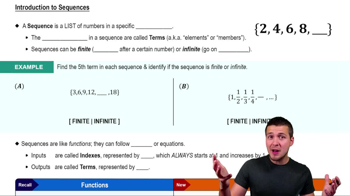
This video solution was recommended by our tutors as helpful for the problem above
Video duration:
2m
Play a video:
0 Comments
Key Concepts
Here are the essential concepts you must grasp in order to answer the question correctly.
Definition of a Sequence Limit
The limit of a sequence is the value that the terms of the sequence approach as the index n goes to infinity. If the terms get arbitrarily close to a finite number, the sequence converges; otherwise, it diverges.
A factorial, denoted n!, is the product of all positive integers up to n. Understanding how factorials grow and simplify, such as (n+1)! = (n+1) × n!, is essential for manipulating sequences involving factorial expressions.
Behavior of Rational Expressions Involving Factorials
When evaluating limits of sequences with factorials in numerator and denominator, simplifying the expression often reveals growth rates. Recognizing that (n+1)!/n! simplifies to (n+1) helps determine whether the sequence diverges or converges.