13–52. Limits of sequences Find the limit of the following sequences or determine that the sequence diverges.
{tan⁻¹(n)}
Verified step by step guidance
1
Recognize that the sequence is given by \( a_n = \tan^{-1}(n) \), where \( \tan^{-1} \) is the inverse tangent function, also known as arctangent.
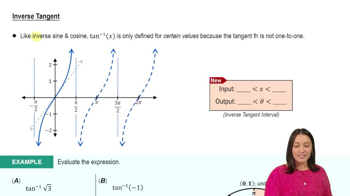
Recall the behavior of the arctangent function: as its input \( x \) approaches infinity, \( \tan^{-1}(x) \) approaches a horizontal asymptote at \( \frac{\pi}{2} \).
Since \( n \) is a sequence that increases without bound (\( n \to \infty \)), consider the limit \( \lim_{n \to \infty} \tan^{-1}(n) \).
Use the known limit property: \( \lim_{x \to \infty} \tan^{-1}(x) = \frac{\pi}{2} \). This implies the sequence \( a_n = \tan^{-1}(n) \) converges to \( \frac{\pi}{2} \).
Conclude that the limit of the sequence \( \{ \tan^{-1}(n) \} \) as \( n \to \infty \) is \( \frac{\pi}{2} \).
Verified video answer for a similar problem:
This video solution was recommended by our tutors as helpful for the problem above
Video duration:
1m
Play a video:
0 Comments
Key Concepts
Here are the essential concepts you must grasp in order to answer the question correctly.
Limits of Sequences
The limit of a sequence is the value that the terms of the sequence approach as the index goes to infinity. If the terms get arbitrarily close to a specific number, the sequence converges to that limit; otherwise, it diverges.
The inverse tangent function, arctan(x), returns the angle whose tangent is x. It is defined for all real numbers and has horizontal asymptotes at ±π/2, meaning as x approaches ±∞, arctan(x) approaches ±π/2.
As the input n grows without bound, arctan(n) approaches its horizontal asymptote π/2. This means the sequence {arctan(n)} converges to π/2, since the values get closer and closer to this limit for large n.