Properties of integrals Consider two functions ƒ and g on [1,6] such that ∫₁⁶ƒ(𝓍) d𝓍 = 10 and ∫₁⁶g(𝓍) d𝓍 = 5, ∫₄⁶ƒ(𝓍) d𝓍 = 5 , and ∫₁⁴g(𝓍) d𝓍 = 2. Evaluate the following integrals.
(d) ∫₄⁶ (g(𝓍) ― f(𝓍) d𝓍
Verified step by step guidance
1
Step 1: Recall the linearity property of definite integrals, which states that the integral of a difference of two functions is the difference of their integrals. Mathematically, ∫ₐᵇ (g(𝓍) - f(𝓍)) d𝓍 = ∫ₐᵇ g(𝓍) d𝓍 - ∫ₐᵇ f(𝓍) d𝓍.
Step 2: Identify the interval of integration for the given problem, which is [4,6]. This means we need to compute ∫₄⁶ g(𝓍) d𝓍 and ∫₄⁶ f(𝓍) d𝓍 separately.
Step 3: Use the additive property of integrals to find ∫₄⁶ g(𝓍) d𝓍. Since ∫₁⁶ g(𝓍) d𝓍 = 5 and ∫₁⁴ g(𝓍) d𝓍 = 2, we can calculate ∫₄⁶ g(𝓍) d𝓍 as ∫₁⁶ g(𝓍) d𝓍 - ∫₁⁴ g(𝓍) d𝓍. Substitute the given values: ∫₄⁶ g(𝓍) d𝓍 = 5 - 2.
Step 4: The value of ∫₄⁶ f(𝓍) d𝓍 is already provided in the problem as 5. This simplifies the computation.
Step 5: Substitute the results into the formula from Step 1: ∫₄⁶ (g(𝓍) - f(𝓍)) d𝓍 = ∫₄⁶ g(𝓍) d𝓍 - ∫₄⁶ f(𝓍) d𝓍. Use the values obtained in Steps 3 and 4 to complete the calculation.
Verified video answer for a similar problem:

This video solution was recommended by our tutors as helpful for the problem above
Video duration:
3m
Play a video:
0 Comments
Key Concepts
Here are the essential concepts you must grasp in order to answer the question correctly.
Properties of Definite Integrals
Definite integrals have several key properties, including linearity and the ability to split intervals. For instance, the integral of a sum of functions can be expressed as the sum of their integrals, and the integral over an interval can be split into the sum of integrals over subintervals. These properties are essential for manipulating and evaluating integrals effectively.
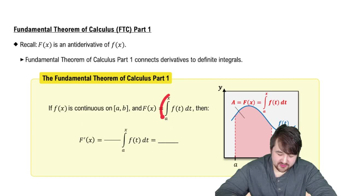
The Fundamental Theorem of Calculus links differentiation and integration, stating that if a function is continuous on [a, b], then the integral of its derivative over that interval gives the net change of the function. This theorem provides a foundation for evaluating definite integrals and understanding the relationship between a function and its antiderivative.
When integrating functions over specific intervals, it is crucial to understand how to apply the properties of integrals to find the area under the curve. For example, knowing the values of integrals over different intervals allows for the calculation of integrals over combined intervals by using the additive property of integrals, which is vital for solving problems involving multiple functions.