Properties of integrals Suppose ∫₀³ƒ(𝓍) d𝓍 = 2 , ∫₃⁶ƒ(𝓍) d𝓍 = ―5 , and ∫₃⁶g(𝓍) d𝓍 = 1. Evaluate the following integrals. (c) ∫₃⁶ (3ƒ(𝓍) ― g(𝓍)) d𝓍
Verified step by step guidance
1
Step 1: Recognize that the integral ∫₃⁶ (3ƒ(𝓍) ― g(𝓍)) d𝓍 can be split into separate integrals using the linearity property of integrals. This property states that ∫ₐᵇ [c₁f(𝓍) + c₂g(𝓍)] d𝓍 = c₁∫ₐᵇ f(𝓍) d𝓍 + c₂∫ₐᵇ g(𝓍) d𝓍.
Step 2: Apply the linearity property to rewrite the integral as ∫₃⁶ (3ƒ(𝓍)) d𝓍 ― ∫₃⁶ g(𝓍) d𝓍.
Step 3: Factor out the constant 3 from the first integral using the constant multiple rule, which states that ∫ₐᵇ c·f(𝓍) d𝓍 = c·∫ₐᵇ f(𝓍) d𝓍. This gives 3∫₃⁶ ƒ(𝓍) d𝓍 ― ∫₃⁶ g(𝓍) d𝓍.
Step 4: Substitute the given values for the integrals. From the problem, ∫₃⁶ ƒ(𝓍) d𝓍 = ―5 and ∫₃⁶ g(𝓍) d𝓍 = 1.
Step 5: Combine the results algebraically to evaluate the expression. The final result will be 3(―5) ― 1.
Verified video answer for a similar problem:
This video solution was recommended by our tutors as helpful for the problem above
Video duration:
2m
Play a video:
0 Comments
Key Concepts
Here are the essential concepts you must grasp in order to answer the question correctly.
Properties of Definite Integrals
Definite integrals have several key properties, including linearity, which states that the integral of a sum is the sum of the integrals, and the integral of a constant multiplied by a function is the constant multiplied by the integral of the function. This allows us to break down complex integrals into simpler parts, making calculations more manageable.
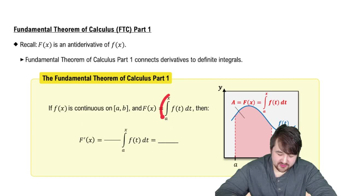
The Fundamental Theorem of Calculus connects differentiation and integration, stating that if a function is continuous on an interval, then the integral of its derivative over that interval equals the change in the function's values at the endpoints. This theorem is essential for evaluating definite integrals and understanding the relationship between a function and its integral.
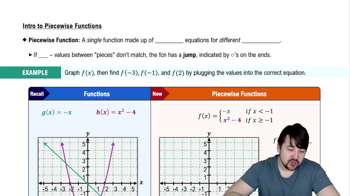
When dealing with piecewise functions, integrals can be evaluated over different intervals where the function may change. This requires calculating the integral separately over each interval and then summing the results. Understanding how to handle piecewise functions is crucial for accurately evaluating integrals that involve different expressions across specified ranges.

 2:20 minutes
 Verified step by step guidance

 05:43
05:43