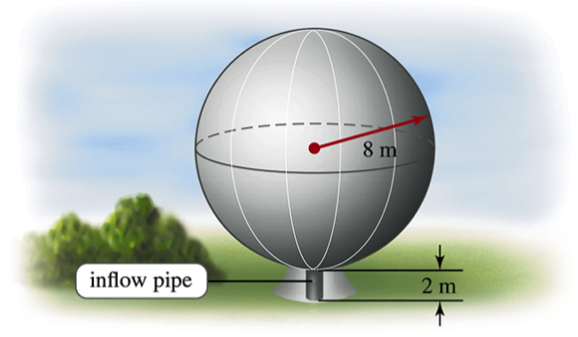
Filling a spherical tank A spherical water tank with an inner radius of 8 m has its lowest point 2 m above the ground. It is filled by a pipe that feeds the tank at its lowest point (see figure). Neglecting the volume of the inflow pipe, how much work is required to fill the tank if it is initially empty?
Verified step by step guidance
1
Identify the physical setup: The spherical tank has a radius of 8 m, and its lowest point is 2 m above the ground. The tank is filled from the bottom through a pipe located at this lowest point.
Set up a coordinate system: Let the vertical axis y measure height from the bottom of the tank (where the pipe is). Thus, y ranges from 0 to 16 m (since the diameter is 16 m).
Express the volume of a thin horizontal slice of water at height y: The cross-sectional area of the slice is a circle with radius r(y) given by the sphere equation. Using the sphere centered at y=8, the radius of the slice is \( r(y) = \sqrt{8^2 - (y - 8)^2} \). The area of the slice is then \( A(y) = \pi r(y)^2 = \pi (64 - (y - 8)^2) \). The volume of a thin slice of thickness \( dy \) is \( dV = A(y) dy \).
Determine the work to lift the slice of water to the top of the tank: The water at height y must be lifted to the top of the tank, which is at height 16 m. The distance the slice must be lifted is \( 16 - y \). The weight of the slice is \( \rho g dV \), where \( \rho \) is the density of water and \( g \) is acceleration due to gravity. The work to lift this slice is \( dW = \rho g (16 - y) A(y) dy \).
Set up the integral for total work: Integrate the expression for \( dW \) from \( y = 0 \) to \( y = 16 \) to find the total work required to fill the tank: \[ W = \int_0^{16} \rho g (16 - y) \pi (64 - (y - 8)^2) dy \].
Verified video answer for a similar problem:
This video solution was recommended by our tutors as helpful for the problem above
Video duration:
5m
Play a video:
0 Comments
Key Concepts
Here are the essential concepts you must grasp in order to answer the question correctly.
Work Done by a Variable Force
Work is the integral of force over distance when the force varies. In this problem, the force needed to lift water changes with the height of the water level, so the total work is found by integrating the force required to move each thin layer of water to the top.
The volume of water in the spherical tank at a given height determines the mass and thus the weight (force) of the water. Using the density of water, the volume of a thin horizontal slice can be calculated, which helps find the force needed to lift that slice.
The tank is spherical, so the cross-sectional area of water at a certain height is a circle whose radius depends on the vertical position. Understanding the geometry allows setting up the integral for volume slices, essential for calculating the work done.