b. It takes 50 N of force to stretch a spring 0.2 m from its equilibrium position. How much work is needed to stretch it an additional 0.5 m?
Verified step by step guidance
1
Identify the spring constant \( k \) using Hooke's Law, which states that the force \( F \) required to stretch or compress a spring by a distance \( x \) is \( F = kx \). Given \( F = 50 \) N and \( x = 0.2 \) m, solve for \( k \) by rearranging the formula to \( k = \frac{F}{x} \).
Express the work done to stretch a spring from position \( x = a \) to \( x = b \) using the integral formula for work: \( W = \int_a^b F(x) \, dx \), where \( F(x) = kx \) is the force at position \( x \).
Set the limits of integration to represent the additional stretch: since the spring is already stretched 0.2 m, the work needed to stretch it an additional 0.5 m corresponds to stretching from \( x = 0.2 \) m to \( x = 0.7 \) m (because \( 0.2 + 0.5 = 0.7 \)).
Write the integral for the work done as \( W = \int_{0.2}^{0.7} kx \, dx \). Substitute the value of \( k \) found in step 1 into this integral.
Evaluate the integral \( \int_{0.2}^{0.7} kx \, dx = k \int_{0.2}^{0.7} x \, dx = k \left[ \frac{x^2}{2} \right]_{0.2}^{0.7} \) to find the work done in stretching the spring the additional 0.5 m.
Verified video answer for a similar problem:
This video solution was recommended by our tutors as helpful for the problem above
Video duration:
2m
Play a video:
0 Comments
Key Concepts
Here are the essential concepts you must grasp in order to answer the question correctly.
Hooke's Law
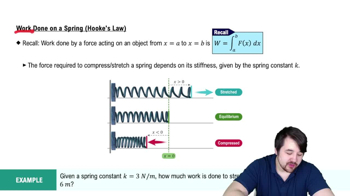
Hooke's Law states that the force required to stretch or compress a spring is proportional to the displacement from its equilibrium position, expressed as F = kx, where k is the spring constant and x is the displacement. This law helps determine the spring constant from the given force and displacement.
When stretching a spring, the force varies with displacement, so work done is calculated by integrating the force over the distance stretched. The work done to stretch a spring from x = a to x = b is W = (1/2)k(b² - a²), reflecting the area under the force-displacement curve.
The spring constant k quantifies the stiffness of the spring and is found by rearranging Hooke's Law: k = F/x. Knowing k allows calculation of work done for any displacement, making it essential to first find k using the initial force and displacement before solving for additional work.