In Exercises 19–26, use implicit differentiation to find dy/dx and then d²y/dx². Write the solutions in terms of x and y only.
2√y = x – y
Verified step by step guidance
1
Start by differentiating both sides of the equation 2√y = x - y with respect to x. Remember that y is a function of x, so use implicit differentiation.
Differentiate the left side: The derivative of 2√y with respect to x is 2 * (1/2) * y^(-1/2) * (dy/dx) = (dy/dx) / √y.
Differentiate the right side: The derivative of x is 1, and the derivative of -y is -dy/dx.
Set the derivatives equal: (dy/dx) / √y = 1 - dy/dx. Solve this equation for dy/dx in terms of x and y.
To find the second derivative d²y/dx², differentiate the expression for dy/dx with respect to x again, using implicit differentiation. Substitute dy/dx from the previous step into this new expression to express d²y/dx² in terms of x and y.
Verified video answer for a similar problem:
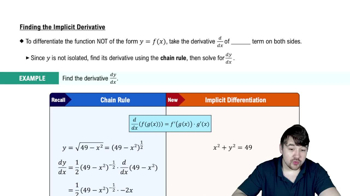
This video solution was recommended by our tutors as helpful for the problem above
Video duration:
12m
Play a video:
0 Comments
Key Concepts
Here are the essential concepts you must grasp in order to answer the question correctly.
Implicit Differentiation
Implicit differentiation is a technique used to find the derivative of a function when it is not explicitly solved for one variable in terms of another. It involves differentiating both sides of an equation with respect to a variable, often x, while treating other variables as implicit functions of x. This method is essential when dealing with equations where y is not isolated.
The first derivative, dy/dx, represents the rate of change of y with respect to x. It is found by applying implicit differentiation to the given equation. In this context, it involves differentiating each term of the equation with respect to x and solving for dy/dx, which provides the slope of the tangent line to the curve at any point (x, y).
The second derivative, d²y/dx², measures the rate of change of the first derivative, providing information about the concavity of the function. To find it, differentiate the expression for dy/dx implicitly with respect to x again. This step requires applying the chain rule and product rule, and the result helps determine the behavior of the function, such as identifying points of inflection.