Parallel tangent lines Find the two points where the curve x² + xy + y² = 7 crosses the x-axis, and show that the tangent lines to the curve at these points are parallel. What is the common slope of these tangent lines?
Verified step by step guidance
1
Step 1: To find the points where the curve crosses the x-axis, set y = 0 in the equation of the curve x² + xy + y² = 7. This simplifies to x² = 7. Solve for x to find the x-coordinates of the points where the curve intersects the x-axis.
Step 2: The solutions to x² = 7 are x = √7 and x = -√7. Therefore, the points where the curve crosses the x-axis are (√7, 0) and (-√7, 0).
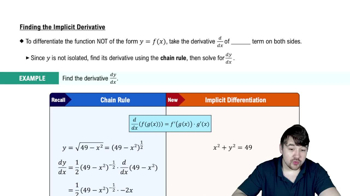
Step 3: To find the slope of the tangent lines at these points, we need to find the derivative of the curve with respect to x. Use implicit differentiation on the equation x² + xy + y² = 7. Differentiate both sides with respect to x.
Step 4: The derivative of the left side with respect to x is 2x + y + x(dy/dx) + 2y(dy/dx). Set this equal to the derivative of the right side, which is 0, and solve for dy/dx to find the slope of the tangent line.
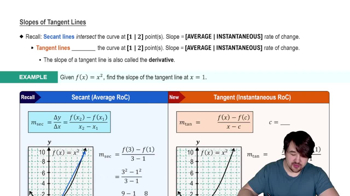
Step 5: Substitute y = 0 and the x-values √7 and -√7 into the derivative equation to find the slope at each point. Show that the slopes are equal, indicating that the tangent lines are parallel. The common slope is the value of dy/dx at these points.
Verified video answer for a similar problem:
This video solution was recommended by our tutors as helpful for the problem above
Video duration:
6m
Play a video:
0 Comments
Key Concepts
Here are the essential concepts you must grasp in order to answer the question correctly.
Finding Points of Intersection
To find where the curve intersects the x-axis, set y = 0 in the equation x² + xy + y² = 7. This simplifies to x² = 7, giving the points of intersection as (√7, 0) and (-√7, 0). These are the points where the curve crosses the x-axis.
Implicit differentiation is used to find the derivative of a function defined implicitly, such as x² + xy + y² = 7. By differentiating both sides with respect to x, and treating y as a function of x, we can find dy/dx, which represents the slope of the tangent line at any point on the curve.
Two lines are parallel if they have the same slope. After finding dy/dx using implicit differentiation, evaluate it at the points of intersection (√7, 0) and (-√7, 0). If the slopes at these points are equal, the tangent lines are parallel. The common slope is the value of dy/dx at these points.