11–86. Applying convergence tests Determine whether the following series converge. Justify your answers. ∑ (from k = 1 to ∞) (10ᵏ + 1) / k¹⁰
Verified step by step guidance
1
Identify the general term of the series: \(a_k = \frac{10^k + 1}{k^{10}}\).
Observe the behavior of the numerator and denominator separately: the numerator grows exponentially as \$10^k\(, while the denominator grows polynomially as \)k^{10}$.
Recall that exponential growth dominates polynomial growth, so \$10^k\( grows much faster than \)k^{10}$ as \(k \to \infty\).
Apply the Divergence Test (also known as the Test for Divergence) by checking the limit of \(a_k\) as \(k\) approaches infinity: calculate \(\lim_{k \to \infty} \frac{10^k + 1}{k^{10}}\).
Since the numerator grows exponentially and the denominator polynomially, this limit does not approach zero; therefore, by the Divergence Test, the series diverges.
Verified video answer for a similar problem:
This video solution was recommended by our tutors as helpful for the problem above
Video duration:
2m
Play a video:
0 Comments
Key Concepts
Here are the essential concepts you must grasp in order to answer the question correctly.
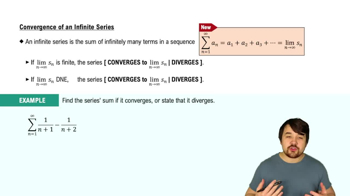
Convergence of Infinite Series
An infinite series converges if the sequence of its partial sums approaches a finite limit. Understanding convergence is essential to determine whether the sum of infinitely many terms results in a finite value or diverges to infinity.
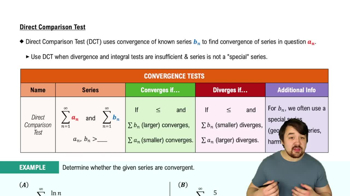
The Comparison Test involves comparing a given series to a second series with known convergence behavior. If the terms of the given series are smaller than those of a convergent series, it also converges; if larger than a divergent series, it diverges.
Exponential terms like 10^k grow much faster than polynomial terms like k^10. When analyzing series terms involving both, the exponential growth dominates, often causing divergence despite the polynomial denominator.