11–86. Applying convergence tests Determine whether the following series converge. Justify your answers. ∑ (from k = 1 to ∞) 1 / (√k × e^(√k))
Verified step by step guidance
1
Identify the general term of the series: \(a_k = \frac{1}{\sqrt{k} \times e^{\sqrt{k}}}\).
Consider the behavior of the term \(a_k\) as \(k \to \infty\). Since \(e^{\sqrt{k}}\) grows very rapidly, the terms \(a_k\) approach zero.
To determine convergence, apply the Comparison Test by comparing \(a_k\) to a simpler series. Note that \(e^{\sqrt{k}}\) grows faster than any polynomial, so compare \(a_k\) to \(\frac{1}{e^{\sqrt{k}}}\).
Since \(\sum \frac{1}{e^{\sqrt{k}}}\) converges (because the terms decrease exponentially), and \(a_k < \frac{1}{e^{\sqrt{k}}}\) for all large \(k\), by the Comparison Test, the original series converges.
Alternatively, you can apply the Integral Test by considering the integral of the function \(f(x) = \frac{1}{\sqrt{x} e^{\sqrt{x}}}\) from 1 to infinity and showing that it converges, which implies the series converges.
Verified video answer for a similar problem:
This video solution was recommended by our tutors as helpful for the problem above
Video duration:
5m
Play a video:
0 Comments
Key Concepts
Here are the essential concepts you must grasp in order to answer the question correctly.
Convergence of Infinite Series
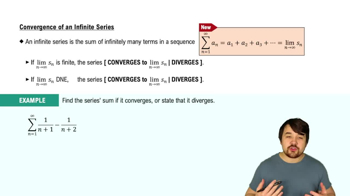
An infinite series converges if the sequence of its partial sums approaches a finite limit. Determining convergence involves analyzing the behavior of the terms as the index grows large, ensuring the sum does not diverge to infinity.
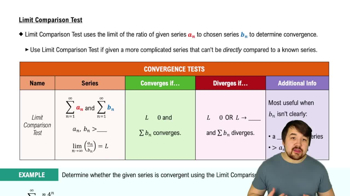
These tests compare the given series to a known benchmark series. If terms of the given series behave similarly to a convergent or divergent series, we can conclude the same about the original series, simplifying convergence analysis.
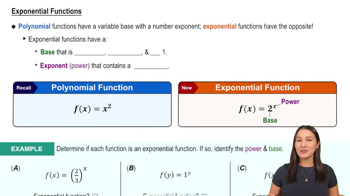
Understanding how exponential functions like e^(√k) grow faster than polynomial or root functions is crucial. This growth rate often dominates the denominator, causing terms to decrease rapidly, which influences the convergence of the series.