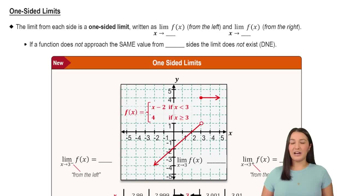
Find the vertical asymptotes. For each vertical asymptote x=a, analyze lim x→a^− f(x) and lim x→a^+f(x).
f(x)=√x^2+2x+6−3 / x−1
Verified step by step guidance
1
Step 1: Identify the points where the function is undefined. The function \( f(x) = \frac{\sqrt{x^2 + 2x + 6} - 3}{x - 1} \) is undefined where the denominator is zero. Set \( x - 1 = 0 \) to find the point where the function is undefined, which gives \( x = 1 \).
Step 2: Check if \( x = 1 \) is a vertical asymptote. A vertical asymptote occurs if the function approaches infinity as \( x \) approaches 1 from either side. We need to analyze the limits \( \lim_{x \to 1^-} f(x) \) and \( \lim_{x \to 1^+} f(x) \).
Step 3: Simplify the expression \( \sqrt{x^2 + 2x + 6} - 3 \) to check the behavior near \( x = 1 \). Consider rationalizing the numerator by multiplying the numerator and the denominator by the conjugate \( \sqrt{x^2 + 2x + 6} + 3 \).
Step 4: After rationalizing, simplify the expression to see if the limit exists or if it approaches infinity. This will help determine the behavior of the function as \( x \to 1^- \) and \( x \to 1^+ \).
Step 5: Evaluate the limits \( \lim_{x \to 1^-} f(x) \) and \( \lim_{x \to 1^+} f(x) \) using the simplified expression to confirm the presence of a vertical asymptote at \( x = 1 \) and determine the direction of the asymptote.
Verified video answer for a similar problem:
This video solution was recommended by our tutors as helpful for the problem above
Video duration:
2m
Play a video:
0 Comments
Key Concepts
Here are the essential concepts you must grasp in order to answer the question correctly.
Vertical Asymptotes
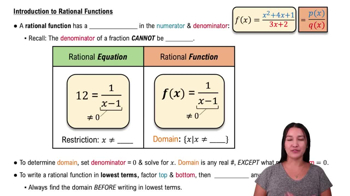
Vertical asymptotes occur in a function when the output approaches infinity as the input approaches a certain value from either the left or the right. This typically happens when the denominator of a rational function equals zero while the numerator does not. Identifying vertical asymptotes involves solving for values of x that make the denominator zero.
Limits are fundamental in calculus, representing the value that a function approaches as the input approaches a certain point. In the context of vertical asymptotes, we analyze the left-hand limit (lim x→a^− f(x)) and the right-hand limit (lim x→a^+ f(x)) to determine the behavior of the function near the asymptote. These limits help us understand whether the function approaches positive or negative infinity.
A rational function is a ratio of two polynomials, expressed as f(x) = P(x)/Q(x), where P and Q are polynomials. The behavior of rational functions, particularly their asymptotic behavior, is influenced by the degrees of the polynomials in the numerator and denominator. Understanding the structure of rational functions is crucial for identifying vertical asymptotes and analyzing limits.

 2:06 minutes
 Verified step by step guidance
 3:40
3:40