Find the vertical asymptotes. For each vertical asymptote x=a, analyze lim x→a^− f(x) and lim x→a^+f(x).
f(x)=3e^x+10 / e^x
Verified step by step guidance
1
Step 1: Identify the form of the function f(x) = \(\frac{3e^x + 10}{e^x}\). This is a rational function where the numerator is 3e^x + 10 and the denominator is e^x.
Step 2: Determine where the denominator is zero, as vertical asymptotes occur where the function is undefined. Set e^x = 0 and solve for x. However, e^x is never zero for any real number x, so there are no vertical asymptotes from the denominator being zero.
Step 3: Simplify the function if possible. Notice that f(x) = \(\frac{3e^x + 10}{e^x}\) can be rewritten as f(x) = 3 + \(\frac{10}{e^x}\).
Step 4: Analyze the behavior of f(x) as x approaches positive and negative infinity. As x → ∞, e^x → ∞, so \(\frac{10}{e^x}\) → 0, and f(x) approaches 3. As x → -∞, e^x → 0, so \(\frac{10}{e^x}\) → ∞, and f(x) approaches ∞.
Step 5: Conclude that there are no vertical asymptotes for this function, but there is a horizontal asymptote at y = 3 as x approaches positive infinity.
Verified video answer for a similar problem:
This video solution was recommended by our tutors as helpful for the problem above
Video duration:
1m
Play a video:
0 Comments
Key Concepts
Here are the essential concepts you must grasp in order to answer the question correctly.
Vertical Asymptotes
Vertical asymptotes occur in a function when the output approaches infinity as the input approaches a certain value from either the left or the right. This typically happens when the function is undefined at that point, often due to division by zero. Identifying vertical asymptotes involves finding values of x that make the denominator zero while ensuring the numerator is not also zero at those points.
Limits are fundamental in calculus, representing the value that a function approaches as the input approaches a certain point. In the context of vertical asymptotes, we analyze the left-hand limit (as x approaches a from the left) and the right-hand limit (as x approaches a from the right) to determine the behavior of the function near the asymptote. This helps in understanding whether the function tends to positive or negative infinity.
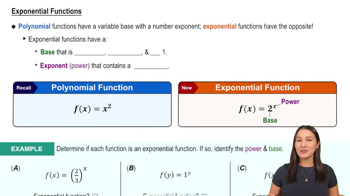
Exponential functions, such as f(x) = 3e^x + 10 / e^x, involve a constant base raised to a variable exponent. These functions exhibit rapid growth or decay, depending on the base and the exponent's sign. Understanding the behavior of exponential functions is crucial for analyzing limits and asymptotic behavior, especially since they can dominate polynomial or rational functions in terms of growth rates.