Tangents and inverses Suppose L(x)=ax+b (with a≠0) is the equation of the line tangent to the graph of a one-to-one function f at (x0,y0). Also, suppose M(x)=cx+d is the equation of the line tangent to the graph of f^−1 at (y0,x0).
c. Prove that L^−1(x)=M(x).
Verified step by step guidance
1
Start by understanding the relationship between a function and its inverse. If L(x) is tangent to f at (x0, y0), then the slope of L(x), which is 'a', is equal to the derivative of f at x0, i.e., f'(x0) = a.
For the inverse function f^−1, the derivative at a point (y0, x0) is the reciprocal of the derivative of f at x0. Therefore, the slope of M(x), which is 'c', is equal to 1/a, i.e., c = 1/a.
The line L(x) = ax + b is tangent to f at (x0, y0), so it passes through the point (x0, y0). Therefore, y0 = ax0 + b, which can be rearranged to find b: b = y0 - ax0.
Similarly, the line M(x) = cx + d is tangent to f^−1 at (y0, x0), so it passes through the point (y0, x0). Therefore, x0 = cy0 + d, which can be rearranged to find d: d = x0 - cy0.
To prove L^−1(x) = M(x), find the inverse of L(x). The inverse L^−1(x) is found by swapping x and y in the equation y = ax + b and solving for y. This gives L^−1(x) = (x - b)/a. Substitute b = y0 - ax0 into this equation to show that L^−1(x) = M(x) = (1/a)x + (x0 - (1/a)y0).
Verified video answer for a similar problem:
This video solution was recommended by our tutors as helpful for the problem above
Video duration:
3m
Play a video:
0 Comments
Key Concepts
Here are the essential concepts you must grasp in order to answer the question correctly.
Inverse Functions
An inverse function essentially reverses the effect of the original function. If f(x) takes an input x and produces an output y, then the inverse function f^−1(y) takes y back to x. For a function to have an inverse, it must be one-to-one, meaning each output is produced by exactly one input.
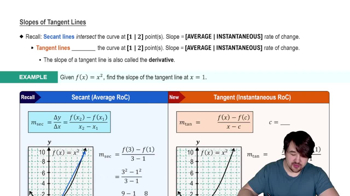
A tangent line to a function at a given point represents the instantaneous rate of change of the function at that point. The slope of the tangent line is given by the derivative of the function at that point. In the context of the problem, the tangent lines L(x) and M(x) represent the slopes of the original function f and its inverse f^−1, respectively.
The derivative of a function at a point provides information about the function's behavior near that point, including its slope. For inverse functions, a key property is that the slopes of the tangent lines at corresponding points are reciprocals of each other. This relationship is crucial for proving that the inverse of the tangent line L(x) equals the tangent line M(x).

 3:53 minutes
 Verified step by step guidance
 4:49
4:49