Tracking a dive A biologist standing at the bottom of an 80-foot vertical cliff watches a peregrine falcon dive from the top of the cliff at a 45° angle from the horizontal (see figure). <IMAGE>
b. What is the rate of change of θ with respect to the bird’s height when it is 60 ft above the ground?
Verified step by step guidance
1
Identify the variables involved: Let θ be the angle of the falcon's dive with respect to the horizontal, and h be the height of the falcon above the ground.
Recognize the relationship between θ and h: Since the falcon is diving at a 45° angle, we can use trigonometric relationships. Specifically, tan(θ) = (80 - h) / x, where x is the horizontal distance from the base of the cliff to the falcon.
Differentiate the relationship with respect to time t: Use implicit differentiation on both sides of the equation tan(θ) = (80 - h) / x to find dθ/dt in terms of dh/dt and dx/dt.
Apply the chain rule: Differentiate tan(θ) with respect to t to get sec²(θ) * (dθ/dt) = (dx/dt * (80 - h) - x * dh/dt) / x².
Substitute known values: When the falcon is 60 ft above the ground, h = 60. Use the given angle and any additional information about the falcon's speed or horizontal distance to solve for dθ/dt.
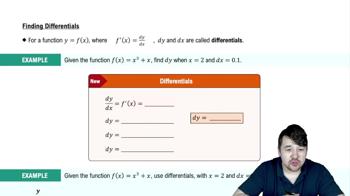
Verified video answer for a similar problem:
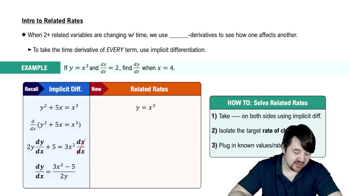
This video solution was recommended by our tutors as helpful for the problem above
Video duration:
11m
Play a video:
0 Comments
Key Concepts
Here are the essential concepts you must grasp in order to answer the question correctly.
Related Rates
Related rates involve finding the rate at which one quantity changes in relation to another. In this problem, we need to determine how the angle θ changes as the height of the falcon changes. This concept is essential for solving problems where multiple variables are interdependent and change over time.
Trigonometric functions, such as sine, cosine, and tangent, relate the angles of a triangle to the lengths of its sides. In this scenario, the angle θ is related to the height of the falcon and the horizontal distance from the cliff. Understanding these functions is crucial for establishing the relationship between the angle and the height.
Differentiation is a fundamental concept in calculus that involves finding the derivative of a function, which represents the rate of change of that function. To find the rate of change of θ with respect to the bird's height, we will need to apply differentiation to the relationship established by the trigonometric functions, allowing us to compute how quickly the angle changes as the falcon descends.