Understand the formal definition of a limit: For the limit \( \lim_{x \to a} f(x) = L \), for every \( \epsilon > 0 \), there exists a \( \delta > 0 \) such that if \( 0 < |x - a| < \delta \), then \( |f(x) - L| < \epsilon \).
Identify the function and the limit: Here, \( f(x) = x^2 \) when \( x \neq 1 \) and \( f(x) = 2 \) when \( x = 1 \). We need to prove that \( \lim_{x \to 1} f(x) = 1 \).
Set \( L = 1 \) and \( a = 1 \). We need to show that for every \( \epsilon > 0 \), there exists a \( \delta > 0 \) such that if \( 0 < |x - 1| < \delta \), then \( |x^2 - 1| < \epsilon \).
Simplify the expression \( |x^2 - 1| \): Notice that \( |x^2 - 1| = |(x - 1)(x + 1)| \). We need to find \( \delta \) such that \( |(x - 1)(x + 1)| < \epsilon \).
Choose \( \delta \) such that \( |x - 1| < \delta \) and ensure that \( |x + 1| \) is bounded. For instance, if \( |x - 1| < 1 \), then \( 0 < x < 2 \), so \( |x + 1| < 3 \). Then, choose \( \delta = \min(1, \frac{\epsilon}{3}) \) to satisfy the condition \( |(x - 1)(x + 1)| < \epsilon \).
Verified video answer for a similar problem:
This video solution was recommended by our tutors as helpful for the problem above
Video duration:
6m
Play a video:
0 Comments
Key Concepts
Here are the essential concepts you must grasp in order to answer the question correctly.
Limit of a Function
The limit of a function as x approaches a particular value is the value that the function approaches as the input gets arbitrarily close to that point. In this context, limx→1 f(x) = 1 means that as x gets closer to 1, f(x) approaches 1, regardless of the function's value at x = 1.
The formal definition of a limit, often called the epsilon-delta definition, states that for every ε > 0, there exists a δ > 0 such that if 0 < |x - c| < δ, then |f(x) - L| < ε. This definition is used to rigorously prove that the limit of f(x) as x approaches c is L, ensuring the function's behavior near the point is consistent with the limit value.
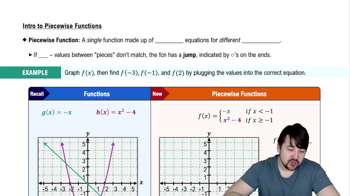
A piecewise function is defined by different expressions based on the input value. In this problem, f(x) is x² when x ≠ 1 and 2 when x = 1. Understanding how to handle piecewise functions is crucial for evaluating limits, as the limit depends on the behavior of the function as x approaches the limit point, not necessarily the function's value at that point.

 6:13 minutes
 Verified step by step guidance
 06:11
06:11