Understand the formal definition of a limit: For a function f(x) and a limit L, the statement lim x→c f(x) = L means that for every ε > 0, there exists a δ > 0 such that if 0 < |x - c| < δ, then |f(x) - L| < ε.
Identify the components of the limit statement: Here, f(x) = 1/x, L = 1, and c = 1. We need to show that for every ε > 0, there exists a δ > 0 such that if 0 < |x - 1| < δ, then |1/x - 1| < ε.
Express the condition |1/x - 1| < ε in terms of x: Start by simplifying the expression |1/x - 1|. This can be rewritten as |(1 - x)/x|. We want this to be less than ε.
Find a suitable δ: To ensure |(1 - x)/x| < ε, we can manipulate the inequality. Notice that |(1 - x)/x| = |1 - x|/|x|. We need to find δ such that |1 - x| < ε|x|. Assume |x - 1| < 1, which implies 0 < x < 2, and thus 1/2 < 1/x < 1. This helps in bounding |x|.
Conclude the proof: Choose δ = min(1, ε/2). This choice ensures that if 0 < |x - 1| < δ, then |1/x - 1| < ε, satisfying the formal definition of the limit. Therefore, lim x→1 1/x = 1 is proven using the formal definition.
Verified video answer for a similar problem:
This video solution was recommended by our tutors as helpful for the problem above
Video duration:
6m
Play a video:
0 Comments
Key Concepts
Here are the essential concepts you must grasp in order to answer the question correctly.
Limit Definition
The formal definition of a limit states that for a function f(x) to have a limit L as x approaches a value a, for every ε > 0, there exists a δ > 0 such that if 0 < |x - a| < δ, then |f(x) - L| < ε. This definition is crucial for rigorously proving limit statements in calculus.
An epsilon-delta proof is a method used to demonstrate the validity of a limit using the formal definition. It involves selecting an appropriate δ for a given ε to show that the function's output can be made arbitrarily close to the limit by choosing inputs sufficiently close to the point of interest.
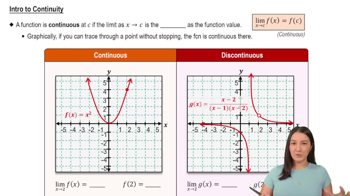
A function is continuous at a point if the limit as x approaches that point equals the function's value at that point. Understanding continuity helps in analyzing limits, as continuous functions behave predictably near their points, making it easier to apply the epsilon-delta definition.

 6:00 minutes
 Verified step by step guidance

 05:43
05:43