45–60. Areas of regions Find the area of the following regions.
The region common to the circles r = 2 sin θ and r = 1
Verified step by step guidance
1
First, understand the problem: we need to find the area of the region common to the two circles given in polar coordinates: \(r = 2 \sin \theta\) and \(r = 1\).
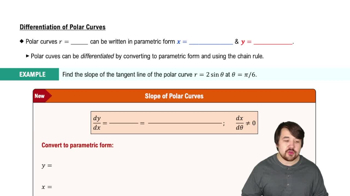
Step 1: Sketch or visualize the two circles to understand their intersection points and the region they enclose. The circle \(r = 2 \sin \theta\) is a circle centered at \((0,1)\) with radius 1, and \(r = 1\) is a circle centered at the origin with radius 1.
Step 2: Find the points of intersection by setting the two equations equal: \(2 \sin \theta = 1\). Solve for \(\theta\) to find the limits of integration for the common region.
Step 3: Set up the integral for the area of the common region. The area enclosed by a polar curve \(r(\theta)\) from \(\alpha\) to \(\beta\) is given by \(\frac{1}{2} \int_{\alpha}^{\beta} r(\theta)^2 \, d\theta\). For the common region, the area will be the sum of areas bounded by each curve between the intersection angles, taking care to integrate the smaller radius where appropriate.
Step 4: Write the integral expressions for the area of the common region by splitting the integral at the intersection points and using the appropriate \(r(\theta)\) for each part. Then, prepare to evaluate these integrals to find the total area.
Verified video answer for a similar problem:
This video solution was recommended by our tutors as helpful for the problem above
Video duration:
4m
Play a video:
0 Comments
Key Concepts
Here are the essential concepts you must grasp in order to answer the question correctly.
Polar Coordinates and Graphing
Polar coordinates represent points using a radius and an angle (r, θ). Understanding how to graph polar equations like r = 2 sin θ and r = 1 helps visualize the regions defined by these curves, which is essential for setting up the area calculation.
The area enclosed by a polar curve r(θ) between angles α and β is given by (1/2) ∫ from α to β of [r(θ)]² dθ. This formula is crucial for finding the area of regions bounded by one or more polar curves.
To find the common region between two polar curves, you must determine their points of intersection by solving r₁(θ) = r₂(θ). These intersection angles define the limits of integration for the area calculation.