45–60. Areas of regions Find the area of the following regions.
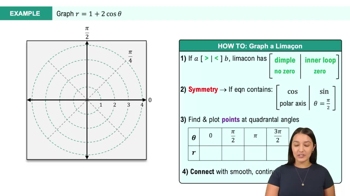
The region inside the outer loop but outside the inner loop of the limaçon r = 3 - 6 sin θ
Verified step by step guidance
1
First, understand the problem: we need to find the area of the region that lies inside the outer loop but outside the inner loop of the limaçon given by the polar equation \(r = 3 - 6 \sin \theta\).
Identify the points where the limaçon intersects itself or where the loops begin and end by solving \(r = 0\), i.e., solve \(3 - 6 \sin \theta = 0\) for \(\theta\). This will give the boundary angles separating the inner and outer loops.
Recall the formula for the area enclosed by a polar curve between two angles \(\alpha\) and \(\beta\) is \(\frac{1}{2} \int_{\alpha}^{\beta} r^2 \, d\theta\). We will use this to find the areas of the outer and inner loops separately.
Set up the integral for the area of the outer loop by integrating \(\frac{1}{2} (3 - 6 \sin \theta)^2\) over the interval corresponding to the outer loop (determined from step 2). Similarly, set up the integral for the inner loop over its corresponding interval.
Subtract the area of the inner loop from the area of the outer loop to find the area of the region inside the outer loop but outside the inner loop.
Verified video answer for a similar problem:
This video solution was recommended by our tutors as helpful for the problem above
Video duration:
6m
Play a video:
0 Comments
Key Concepts
Here are the essential concepts you must grasp in order to answer the question correctly.
Polar Coordinates and Graphing Polar Curves
Polar coordinates represent points using a radius and an angle, making it easier to describe curves like limaçons. Understanding how to plot and interpret the graph of r = 3 - 6 sin θ is essential to visualize the inner and outer loops and identify the regions described.
The area enclosed by a polar curve between two angles is found using the integral of (1/2)r² dθ. Calculating areas of regions bounded by loops requires setting up integrals with correct limits and sometimes subtracting areas to find regions inside one loop but outside another.
Identifying and Distinguishing Inner and Outer Loops of a Limaçon
Limaçons can have inner loops when the curve crosses the pole multiple times. Recognizing the angles where r = 0 helps determine the boundaries of inner and outer loops, which is crucial for setting integration limits to find the area between these loops.