41–44. {Use of Tech} Remainders and estimates Consider the following convergent series.
b. Find how many terms are needed to ensure that the remainder is less than 10⁻³.
41. ∑ (k = 1 to ∞) 1 / k⁶
Verified step by step guidance
1
Recognize that the series given is \( \sum_{k=1}^{\infty} \frac{1}{k^6} \), which is a convergent p-series with \( p = 6 > 1 \).
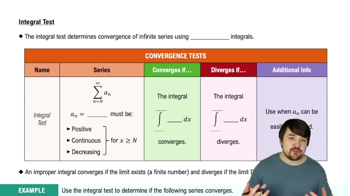
To estimate the remainder \( R_n = \sum_{k=n+1}^{\infty} \frac{1}{k^6} \), use the integral test remainder estimate, which states that \( R_n \leq \int_n^{\infty} \frac{1}{x^6} \, dx \).
Set up the integral \( \int_n^{\infty} x^{-6} \, dx \) and evaluate it: \( \int_n^{\infty} x^{-6} \, dx = \lim_{t \to \infty} \int_n^t x^{-6} \, dx \).
Calculate the definite integral: \( \int_n^t x^{-6} \, dx = \left[ \frac{x^{-5}}{-5} \right]_n^t = \frac{1}{5 n^5} - \lim_{t \to \infty} \frac{1}{5 t^5} \). Since \( \lim_{t \to \infty} \frac{1}{t^5} = 0 \), the integral equals \( \frac{1}{5 n^5} \).
Set the remainder estimate less than \( 10^{-3} \): \( \frac{1}{5 n^5} < 10^{-3} \). Solve this inequality for \( n \) to find the minimum number of terms needed.
Verified video answer for a similar problem:
This video solution was recommended by our tutors as helpful for the problem above
Video duration:
3m
Play a video:
0 Comments
Key Concepts
Here are the essential concepts you must grasp in order to answer the question correctly.
Convergent Series
A convergent series is an infinite sum whose partial sums approach a finite limit. For the series ∑ 1/k⁶, since the exponent 6 > 1, it converges by the p-series test. Understanding convergence ensures the remainder (error) after a finite number of terms is well-defined and can be estimated.
The remainder after n terms is the difference between the infinite sum and the nth partial sum. For positive, decreasing terms, the remainder can be bounded to estimate how many terms are needed to achieve a desired accuracy, such as ensuring the remainder is less than 10⁻³.
The integral test compares a series to an improper integral to determine convergence and estimate remainders. For decreasing positive functions, the remainder after n terms is less than the integral from n to infinity of the function, providing a practical way to find the number of terms needed for a given error bound.