41–44. {Use of Tech} Remainders and estimates Consider the following convergent series.
a. Find an upper bound for the remainder in terms of n.
41. ∑ (k = 1 to ∞) 1 / k⁶
Verified step by step guidance
1
Recognize that the series \( \sum_{k=1}^{\infty} \frac{1}{k^6} \) is a convergent p-series with \( p = 6 > 1 \), which ensures convergence.
To find an upper bound for the remainder \( R_n = \sum_{k=n+1}^{\infty} \frac{1}{k^6} \), use the integral test remainder estimate, which states that \( R_n \leq \int_{n}^{\infty} \frac{1}{x^6} \, dx \).
Set up the improper integral \( \int_{n}^{\infty} x^{-6} \, dx \) to estimate the remainder.
Compute the antiderivative of \( x^{-6} \), which is \( \frac{x^{-5}}{-5} \), then apply the limits from \( n \) to \( \infty \) to express the upper bound for the remainder \( R_n \).
Verified video answer for a similar problem:
This video solution was recommended by our tutors as helpful for the problem above
Video duration:
2m
Play a video:
0 Comments
Key Concepts
Here are the essential concepts you must grasp in order to answer the question correctly.
Convergence of Infinite Series
An infinite series converges if the sum of its terms approaches a finite limit as the number of terms increases. For series like ∑ 1/k⁶, which is a p-series with p > 1, convergence is guaranteed. Understanding convergence is essential to discuss remainders and error bounds.
The remainder after n terms of a convergent series is the difference between the infinite sum and the partial sum up to n. Estimating this remainder helps determine how close the partial sum is to the actual sum, which is crucial for approximations and error analysis.
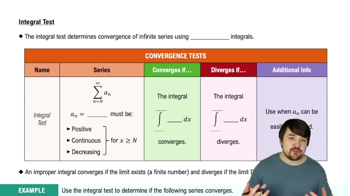
The integral test can be used to estimate the remainder of a decreasing positive term series by comparing the tail of the series to an improper integral. This provides an upper bound for the remainder, making it a practical tool for bounding errors in series approximations.