13–52. Limits of sequences Find the limit of the following sequences or determine that the sequence diverges.
{n³⁄(n⁴ + 1)}
Verified step by step guidance
1
Identify the given sequence: \(a_n = \frac{n^3}{n^4 + 1}\).
To find the limit as \(n\) approaches infinity, analyze the highest powers of \(n\) in the numerator and denominator.
Divide both the numerator and denominator by \(n^4\), the highest power in the denominator, to simplify the expression: \(a_n = \frac{\frac{n^3}{n^4}}{\frac{n^4}{n^4} + \frac{1}{n^4}} = \frac{\frac{1}{n}}{1 + \frac{1}{n^4}}\).
Evaluate the limit of each part as \(n \to \infty\): \(\frac{1}{n} \to 0\) and \(\frac{1}{n^4} \to 0\), so the expression simplifies to \(\frac{0}{1 + 0} = 0\).
Conclude that the limit of the sequence \(a_n\) as \(n\) approaches infinity is 0.
Verified video answer for a similar problem:
This video solution was recommended by our tutors as helpful for the problem above
Video duration:
2m
Play a video:
0 Comments
Key Concepts
Here are the essential concepts you must grasp in order to answer the question correctly.
Limits of Sequences
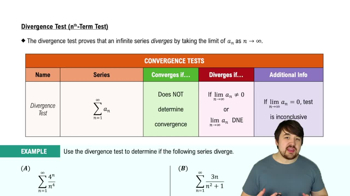
The limit of a sequence describes the value that the terms of the sequence approach as the index n becomes very large. If the terms get arbitrarily close to a specific number, the sequence converges to that limit; otherwise, it diverges.
When evaluating limits of sequences involving polynomials, focus on the highest degree terms in the numerator and denominator. These dominant terms determine the behavior of the sequence as n approaches infinity, simplifying the limit calculation.
For sequences defined by rational functions, the limit as n approaches infinity depends on the degrees of the numerator and denominator polynomials. If the numerator's degree is less, the limit is zero; if equal, the limit is the ratio of leading coefficients; if greater, the sequence diverges.