35–44. Limits of sequences Write the terms a₁, a₂, a₃, and a₄ of the following sequences. If the sequence appears to converge, make a conjecture about its limit. If the sequence diverges, explain why. aₙ = 3 + cos(π*ⁿ) ; n = 1, 2, 3, …
Verified step by step guidance
1
Identify the general term of the sequence: \(a_n = 3 + \cos(\pi n)\), where \(n = 1, 2, 3, \ldots\).
Calculate the first four terms by substituting \(n = 1, 2, 3, 4\) into the formula: \(a_1 = 3 + \cos(\pi \times 1)\), \(a_2 = 3 + \cos(\pi \times 2)\), \(a_3 = 3 + \cos(\pi \times 3)\), and \(a_4 = 3 + \cos(\pi \times 4)\).
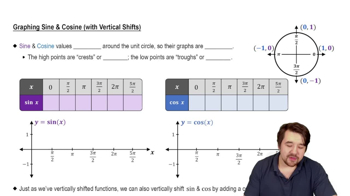
Recall that \(\cos(\pi n)\) alternates between \(-1\) and \(1\) depending on whether \(n\) is odd or even, because \(\cos(\pi) = -1\) and \(\cos(2\pi) = 1\).
Use this pattern to find the values of the first four terms explicitly, noting the alternating behavior.
Analyze the pattern of the terms to determine if the sequence converges to a single value or diverges by oscillating between two values.
Verified video answer for a similar problem:
This video solution was recommended by our tutors as helpful for the problem above
Video duration:
2m
Play a video:
0 Comments
Key Concepts
Here are the essential concepts you must grasp in order to answer the question correctly.
Sequences and Their Terms
A sequence is an ordered list of numbers defined by a specific formula for its nth term. Understanding how to compute individual terms, such as a₁, a₂, a₃, and a₄, is essential for analyzing the behavior of the sequence. This involves substituting values of n into the given formula.
The limit of a sequence is the value that the terms approach as n becomes very large. If the terms get arbitrarily close to a fixed number, the sequence converges to that limit. Otherwise, it diverges, meaning it does not settle near any single value.
The cosine function oscillates between -1 and 1 periodically. When combined with sequences involving powers, such as cos(πⁿ), its values can alternate or follow a pattern affecting convergence. Recognizing this oscillation helps determine if the sequence converges or diverges.

 2:43 minutes
 Verified step by step guidance
 8:22
8:22