72–75. {Use of Tech} Practical sequences Consider the following situations that generate a sequence
a.Write out the first five terms of the sequence.
Drug elimination Jack took a 200-mg dose of a pain killer at midnight. Every hour, 5% of the drug is washed out of his bloodstream. Let dₙ be the amount of drug in Jack’s blood n hours after the drug was taken, where d₀ = 200mg.
Verified step by step guidance
1
Identify the initial amount of the drug in Jack's bloodstream, which is given as \(d_0 = 200\) mg at time \(n=0\) hours.
Understand that every hour, 5% of the drug is eliminated, meaning 95% remains. This implies the sequence is geometric with a common ratio \(r = 0.95\).
Write the general formula for the amount of drug after \(n\) hours as \(d_n = d_0 \times r^n = 200 \times (0.95)^n\).
Calculate the first five terms by substituting \(n = 0, 1, 2, 3, 4\) into the formula: \(d_0, d_1, d_2, d_3, d_4\).
Express each term as \(d_n = 200 \times (0.95)^n\) without simplifying the numerical values, to clearly show the pattern of the sequence.
Verified video answer for a similar problem:
This video solution was recommended by our tutors as helpful for the problem above
Video duration:
3m
Play a video:
0 Comments
Key Concepts
Here are the essential concepts you must grasp in order to answer the question correctly.
Geometric Sequences
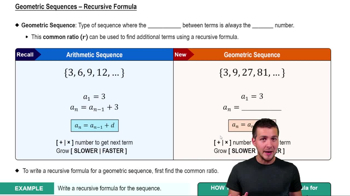
A geometric sequence is a sequence where each term is found by multiplying the previous term by a constant ratio. In this problem, the amount of drug decreases by a fixed percentage each hour, making it a geometric sequence with a common ratio less than 1.
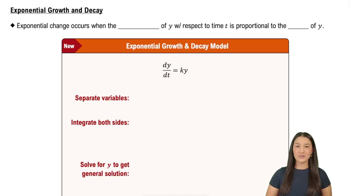
Exponential decay describes processes where quantities decrease at a rate proportional to their current value. Here, the drug amount decreases by 5% every hour, modeling exponential decay, which is key to understanding how the drug concentration changes over time.
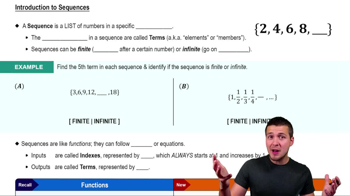
Sequence notation uses subscripts to denote terms, such as dₙ for the nth term. Calculating terms involves applying the decay factor repeatedly starting from the initial value, allowing us to write out specific terms like d₁, d₂, etc.