57–60. Heights of bouncing balls A ball is thrown upward to a height of hₒ meters. After each bounce, the ball rebounds to a fraction r of its previous height. Let hₙ be the height after the nth bounce. Consider the following values of hₒ and r.
a. Find the first four terms of the sequence of heights {hₙ}.
h₀ = 20,r = 0.5
Verified step by step guidance
1
Understand the problem: The ball starts at an initial height \(h_0 = 20\) meters. After each bounce, it reaches a height that is a fraction \(r = 0.5\) of the previous height. We want to find the first four terms of the sequence \(\{h_n\}\), where \(h_n\) is the height after the \(n\)th bounce.
Recall the formula for the height after the \(n\)th bounce: \(h_n = h_0 \times r^n\). This means each term is the initial height multiplied by the rebound fraction raised to the power of the bounce number.
Calculate the first four terms by substituting \(n = 0, 1, 2, 3\) into the formula:
\[h_0 = 20 \times 0.5^0\]
\[h_1 = 20 \times 0.5^1\]
\[h_2 = 20 \times 0.5^2\]
\[h_3 = 20 \times 0.5^3\]
Verified video answer for a similar problem:
This video solution was recommended by our tutors as helpful for the problem above
Video duration:
2m
Play a video:
0 Comments
Key Concepts
Here are the essential concepts you must grasp in order to answer the question correctly.
Geometric Sequences
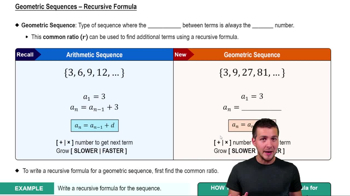
A geometric sequence is a sequence of numbers where each term is found by multiplying the previous term by a constant ratio. In this problem, the heights after each bounce form a geometric sequence with initial term h₀ and common ratio r, representing the fraction of height retained after each bounce.
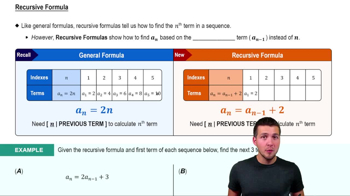
Sequences can be described recursively, where each term depends on the previous one, or explicitly, where the nth term is given directly. Here, hₙ = r * hₙ₋₁ defines the recursive formula, and hₙ = h₀ * rⁿ is the explicit formula to find the height after the nth bounce.
Exponents are used to express repeated multiplication, essential for calculating terms in geometric sequences. Since each bounce height is multiplied by r repeatedly, exponents allow us to compute hₙ efficiently as h₀ times r raised to the power n.