Probability as an integral Two points P and Q are chosen randomly, one on each of two adjacent sides of a unit square (see figure). What is the probability that the area of the triangle formed by the sides of the square and the line segment PQ is less than one-fourth the area of the square? Begin by showing that x and y must satisfy xy < 1/2 in order for the area condition to be met. Then argue that the required probability is: 1/2 + ∫[1/2 to 1] (dx / 2x) and evaluate the integral.
Verified step by step guidance
1
Step 1: Define the points P and Q on the unit square. Let P be on the x-axis at coordinate (x, 0) where 0 ≤ x ≤ 1, and Q be on the y-axis at coordinate (0, y) where 0 ≤ y ≤ 1.
Step 2: Express the area of the triangle formed by the x-axis, y-axis, and the line segment PQ. The triangle has vertices at (0,0), (x,0), and (0,y). The area of this right triangle is given by \(\frac{1}{2}xy\).
Step 3: Set up the inequality for the area condition. Since the area of the square is 1, the problem states the triangle's area must be less than one-fourth of the square's area, so \(\frac{1}{2}xy < \frac{1}{4}\). Simplify this inequality to get \(xy < \frac{1}{2}\).
Step 4: Interpret the probability problem as finding the probability that the randomly chosen points (x,y) in the unit square satisfy \(xy < \frac{1}{2}\). Since x and y are independent and uniformly distributed on [0,1], the probability corresponds to the area under the curve \(y = \frac{1}{2x}\) for x in [0,1].
Step 5: Express the probability as the sum of two parts: the area where x ≤ 1/2 (where \(xy < 1/2\) is always true) and the integral from 1/2 to 1 of the function \(\frac{1}{2x}\) with respect to x. This gives the probability as \(\frac{1}{2} + \int_{1/2}^1 \frac{1}{2x} \, dx\). The next step would be to evaluate this integral.
Verified video answer for a similar problem:
This video solution was recommended by our tutors as helpful for the problem above
Video duration:
3m
Play a video:
0 Comments
Key Concepts
Here are the essential concepts you must grasp in order to answer the question correctly.
Geometric Probability
Geometric probability involves finding the likelihood of an event by measuring areas, lengths, or volumes in a geometric setting. Here, points P and Q are chosen randomly on the sides of a unit square, and the probability is related to the area of a region defined by inequalities involving x and y coordinates.
The area of a triangle formed by points on coordinate axes can be expressed using the coordinates of those points. In this problem, the triangle formed by the square sides and segment PQ has area related to the product xy, which helps set up the inequality xy < 1/2 for the area condition.
Definite integrals can be used to calculate probabilities when the event corresponds to a continuous range of values. The integral ∫[1/2 to 1] (dx / 2x) represents the probability over a specific region, and evaluating this integral gives the exact probability of the area condition being met.

 3:42 minutes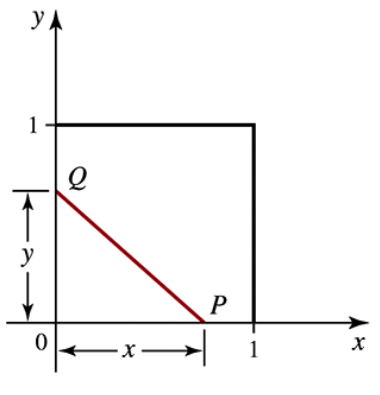
 Verified step by step guidance
 04:18
04:18