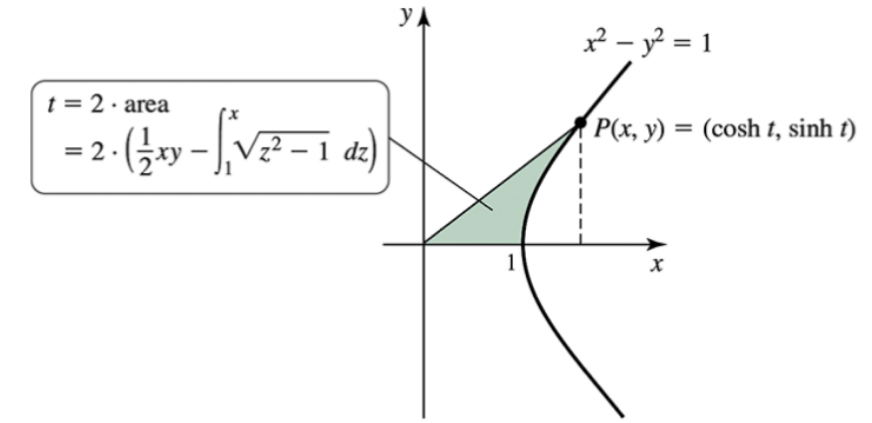
Definitions of hyperbolic sine and cosine Complete the following steps to prove that when the x- and y-coordinates of a point on the hyperbola x² - y² = 1 are defined as cosh t and sinh t, respectively, where t is twice the area of the shaded region in the figure, x and y can be expressed as x = cosh t = (eᵗ + e⁻ᵗ) / 2 and y = sinh t = (eᵗ - e⁻ᵗ) / 2.
b. In Chapter 8, the formula for the integral in part (a) is derived: ∫ √(z² − 1) dz = (z/2)√(z² − 1) − (1/2) ln|z + √(z² − 1)| + C. Evaluate this integral on the interval [1, x], explain why the absolute value can be dropped, and combine the result with part (a) to show that: t = ln(x + √(x² − 1)).
Verified step by step guidance
1
Start by expressing the parameter \( t \) as twice the shaded area, which is given by the formula: \[ t = 2 \left( \frac{1}{2} x y - \int_1^x \sqrt{z^2 - 1} \, dz \right) \]. This represents the area of the triangle minus the area under the curve from 1 to \( x \).
Recognize that the point \( P(x, y) \) lies on the hyperbola \( x^2 - y^2 = 1 \), and the coordinates are defined as \( x = \cosh t \) and \( y = \sinh t \). This means \( y = \sqrt{x^2 - 1} \) because \( y^2 = x^2 - 1 \).
Use the integral formula provided: \[ \int \sqrt{z^2 - 1} \, dz = \frac{z}{2} \sqrt{z^2 - 1} - \frac{1}{2} \ln|z + \sqrt{z^2 - 1}| + C \]. Evaluate this definite integral from 1 to \( x \) by substituting the limits into the antiderivative.
Explain why the absolute value in the logarithm can be dropped: since \( x \geq 1 \) and \( \sqrt{x^2 - 1} \geq 0 \), the expression inside the logarithm, \( x + \sqrt{x^2 - 1} \), is always positive, so \( |x + \sqrt{x^2 - 1}| = x + \sqrt{x^2 - 1} \).
Combine the evaluated integral with the expression for \( t \) from step 1, simplify the terms, and show that \( t = \ln(x + \sqrt{x^2 - 1}) \). This links the parameter \( t \) to the coordinates on the hyperbola and completes the proof.
Verified video answer for a similar problem:
This video solution was recommended by our tutors as helpful for the problem above
Video duration:
2m
Play a video:
0 Comments
Key Concepts
Here are the essential concepts you must grasp in order to answer the question correctly.
Hyperbolic Functions (sinh and cosh)
Hyperbolic sine (sinh) and cosine (cosh) are analogs of the trigonometric sine and cosine but for a hyperbola. They are defined as sinh t = (e^t - e^(-t))/2 and cosh t = (e^t + e^(-t))/2. These functions satisfy the identity cosh² t - sinh² t = 1, which corresponds to the equation of the hyperbola x² - y² = 1.
Area Interpretation and Parametrization of the Hyperbola
The parameter t is defined as twice the area of the shaded region bounded by the hyperbola, the x-axis, and the vertical line at x. This geometric interpretation links the hyperbolic functions to the integral of √(z² - 1), providing a way to parametrize points on the hyperbola as (cosh t, sinh t).
The integral ∫√(z² - 1) dz evaluates to (z/2)√(z² - 1) - (1/2) ln|z + √(z² - 1)| + C. Evaluating this from 1 to x and dropping the absolute value (since x ≥ 1) leads to the expression t = ln(x + √(x² - 1)), connecting the parameter t to x and thus to cosh t.