Particular antiderivatives For the following functions f, find the antiderivative F that satisfies the given condition.
f(v) = sec v tan v; F(0) = 2, -π/2 < v < π/2
Verified step by step guidance
1
Identify the given function: \(f(v) = \sec v \tan v\). We need to find an antiderivative \(F(v)\) such that \(F'(v) = f(v)\) and \(F(0) = 2\).
Recall the derivative of \(\sec v\) is \(\frac{d}{dv}(\sec v) = \sec v \tan v\). This suggests that \(F(v)\) might be related to \(\sec v\).
Write the general antiderivative: \(F(v) = \sec v + C\), where \(C\) is the constant of integration.
Use the initial condition \(F(0) = 2\) to solve for \(C\). Substitute \(v = 0\) into \(F(v)\): \(F(0) = \sec 0 + C = 1 + C\).
Set \$1 + C = 2\( and solve for \)C\(. Then write the particular antiderivative \(F(v) = \sec v + C\) with the found value of \)C$.
Verified video answer for a similar problem:
This video solution was recommended by our tutors as helpful for the problem above
Video duration:
2m
Play a video:
0 Comments
Key Concepts
Here are the essential concepts you must grasp in order to answer the question correctly.
Antiderivatives and Indefinite Integrals
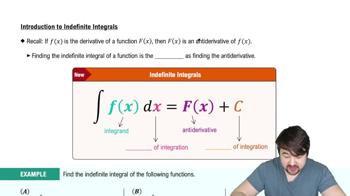
An antiderivative of a function f is another function F whose derivative is f. Finding an antiderivative involves integrating f without specific limits, resulting in a family of functions differing by a constant. This concept is fundamental for solving the given problem where we seek F such that F' = f.
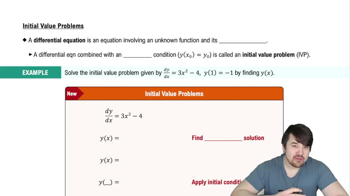
When an initial condition like F(0) = 2 is given, it allows us to determine the constant of integration in the antiderivative. This transforms the general solution into a particular solution that satisfies both the differential equation and the specified value at a point.
Integrating functions involving secant and tangent requires knowledge of trigonometric identities and standard integrals. For example, the integral of sec v tan v is sec v plus a constant. Recognizing these forms simplifies finding the antiderivative efficiently.