Calculating work for different springs Calculate the work required to stretch the following springs 0.4 m from their equilibrium positions. Assume Hooke’s law is obeyed. b. A spring that requires 2 J of work to be stretched 0.1 m from its equilibrium position
Verified step by step guidance
1
Recall that the work done to stretch or compress a spring from its equilibrium position is given by the formula \(W = \frac{1}{2} k x^2\), where \(k\) is the spring constant and \(x\) is the displacement from equilibrium.
Use the information given for the spring: it requires 2 J of work to stretch it 0.1 m. Substitute these values into the work formula to find the spring constant \(k\): \(2 = \frac{1}{2} k (0.1)^2\).
Solve the equation for \(k\) by isolating it: multiply both sides by 2 and divide by \((0.1)^2\) to get \(k = \frac{2 \times 2}{(0.1)^2}\).
Now that you have the spring constant \(k\), use it to calculate the work required to stretch the spring 0.4 m by substituting into the work formula: \(W = \frac{1}{2} k (0.4)^2\).
Simplify the expression to find the work done for the 0.4 m stretch, which will give you the answer to the problem.
Verified video answer for a similar problem:
This video solution was recommended by our tutors as helpful for the problem above
Video duration:
4m
Play a video:
0 Comments
Key Concepts
Here are the essential concepts you must grasp in order to answer the question correctly.
Hooke's Law
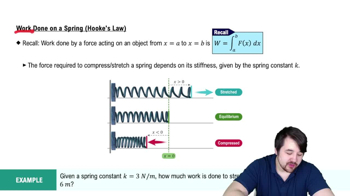
Hooke's Law states that the force required to stretch or compress a spring is proportional to the displacement from its equilibrium position, expressed as F = kx, where k is the spring constant and x is the displacement. This linear relationship is fundamental for calculating forces and work in spring problems.
When stretching a spring, the force varies with displacement, so work is calculated as the integral of force over distance. For springs, work done W = (1/2)kx², representing the area under the force-displacement curve, which is essential for determining energy stored or work required.
Given the work done to stretch a spring a certain distance, the spring constant k can be found by rearranging the work formula: k = 2W / x². This allows solving for k when work and displacement are known, enabling calculation of work for other displacements.