Work from force How much work is required to move an object from x=1 to x=3 (measured in meters) in the presence of a force (in N) given by F(x) = 2x² acting along the x-axis?
Table of contents
- 0. Functions7h 55m
- Introduction to Functions18m
- Piecewise Functions10m
- Properties of Functions9m
- Common Functions1h 8m
- Transformations5m
- Combining Functions27m
- Exponent rules32m
- Exponential Functions28m
- Logarithmic Functions24m
- Properties of Logarithms36m
- Exponential & Logarithmic Equations35m
- Introduction to Trigonometric Functions38m
- Graphs of Trigonometric Functions44m
- Trigonometric Identities47m
- Inverse Trigonometric Functions48m
- 1. Limits and Continuity2h 2m
- 2. Intro to Derivatives1h 33m
- 3. Techniques of Differentiation3h 18m
- 4. Applications of Derivatives2h 38m
- 5. Graphical Applications of Derivatives6h 2m
- 6. Derivatives of Inverse, Exponential, & Logarithmic Functions2h 37m
- 7. Antiderivatives & Indefinite Integrals1h 26m
- 8. Definite Integrals4h 44m
- 9. Graphical Applications of Integrals2h 27m
- 10. Physics Applications of Integrals 3h 16m
- 11. Integrals of Inverse, Exponential, & Logarithmic Functions2h 31m
- 12. Techniques of Integration7h 41m
- 13. Intro to Differential Equations2h 55m
- 14. Sequences & Series5h 36m
- 15. Power Series2h 19m
- 16. Parametric Equations & Polar Coordinates7h 58m
10. Physics Applications of Integrals
Work
Problem 6.7.24b
Textbook Question
Compressing and stretching a spring Suppose a force of 15 N is required to stretch and hold a spring 0.25 m from its equilibrium position.
b. How much work is required to compress the spring 0.2 m from its equilibrium position?
Verified step by step guidance1
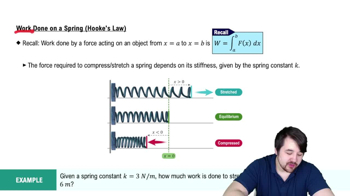
Identify the spring constant \( k \) using Hooke's Law, which states that the force \( F \) required to stretch or compress a spring is proportional to the displacement \( x \) from its equilibrium position: \( F = kx \). Given \( F = 15 \) N and \( x = 0.25 \) m, solve for \( k \) by rearranging the formula to \( k = \frac{F}{x} \).
Recall that the work \( W \) done in compressing or stretching a spring from the equilibrium position to a displacement \( x \) is given by the integral of the force over the distance, which simplifies to the formula \( W = \frac{1}{2}kx^2 \).
Substitute the value of \( k \) found in step 1 and the compression distance \( x = 0.2 \) m into the work formula \( W = \frac{1}{2}kx^2 \).
Set up the expression for the work done: \( W = \frac{1}{2} \times k \times (0.2)^2 \).
Evaluate the expression to find the amount of work required to compress the spring 0.2 m from its equilibrium position (do not calculate the final numeric value here, just set up the expression).
Verified video answer for a similar problem:This video solution was recommended by our tutors as helpful for the problem above
Video duration:
2mPlay a video:
Key Concepts
Here are the essential concepts you must grasp in order to answer the question correctly.
Hooke's Law
Hooke's Law states that the force needed to stretch or compress a spring is proportional to the displacement from its equilibrium position, expressed as F = kx, where k is the spring constant and x is the displacement. This law helps determine the spring constant from given force and displacement values.
Recommended video:
Work Done On A Spring (Hooke's Law)
Spring Constant Calculation
The spring constant k measures the stiffness of a spring and is calculated by dividing the applied force by the displacement (k = F/x). Knowing k allows us to analyze forces and work involved in stretching or compressing the spring at different distances.
Recommended video:
Work Done On A Spring (Hooke's Law)
Work Done on a Spring
The work done to compress or stretch a spring is the energy stored in it, calculated by the integral of force over displacement. For a spring, work W = (1/2)kx², representing the area under the force-displacement curve, which is essential for finding the energy required to compress the spring.
Recommended video:
Work Done On A Spring (Hooke's Law)
Watch next
Master Introduction To Work with a bite sized video explanation from Patrick
Start learningRelated Videos
Related Practice
Textbook Question
33
views