In Exercises 3 and 4, find the domains of f, g, f/g and g/f.
f(x) = 1, g(x) = 1 + √x
Verified step by step guidance
1
Step 1: Determine the domain of f(x) = 1. Since f(x) is a constant function, it is defined for all real numbers. Therefore, the domain of f is all real numbers, which can be expressed as (-∞, ∞).
Step 2: Determine the domain of g(x) = 1 + √x. The square root function √x is defined for x ≥ 0. Therefore, the domain of g is [0, ∞).
Step 3: Determine the domain of the quotient f/g. The function f/g(x) = 1 / (1 + √x) is defined where both f and g are defined and g(x) ≠ 0. Since g(x) = 1 + √x is never zero for x ≥ 0, the domain of f/g is [0, ∞).
Step 4: Determine the domain of the quotient g/f. The function g/f(x) = (1 + √x) / 1 is defined where both g and f are defined. Since f(x) = 1 is never zero, the domain of g/f is the intersection of the domains of g and f, which is [0, ∞).
Step 5: Summarize the domains: The domain of f is (-∞, ∞), the domain of g is [0, ∞), the domain of f/g is [0, ∞), and the domain of g/f is [0, ∞).
Verified video answer for a similar problem:
This video solution was recommended by our tutors as helpful for the problem above
Video duration:
4m
Play a video:
0 Comments
Key Concepts
Here are the essential concepts you must grasp in order to answer the question correctly.
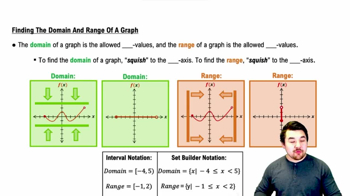
Domain of a Function
The domain of a function is the set of all possible input values (x-values) for which the function is defined. For example, in the function g(x) = 1 + √x, the domain is restricted to x ≥ 0 because the square root of a negative number is not defined in the real number system.
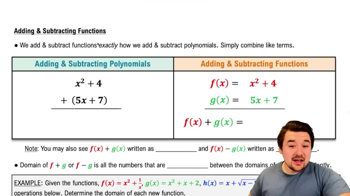
Algebraic combinations of functions involve operations such as addition, subtraction, multiplication, and division of two or more functions. For instance, f/g and g/f represent the division of functions f and g, which requires careful consideration of their domains to avoid undefined expressions, particularly where the denominator equals zero.
When combining functions, certain restrictions may apply to the resulting function's domain. For example, in the case of f/g, the domain must exclude any x-values that make g(x) = 0, as division by zero is undefined. Therefore, analyzing the individual domains of f and g is crucial to determine the overall domain of their combination.