Identify the functions involved in the composition. Let's say we have two functions, f(x) and g(x). The composition of these functions is denoted as (f ∘ g)(x), which means f(g(x)).
Determine the domain of the inner function, g(x). This is the set of all x-values for which g(x) is defined.
Evaluate the inner function, g(x), for the given x-values in the table. Substitute each x-value into g(x) to find the corresponding output.
Substitute the output of g(x) into the outer function, f(x). For each x-value, use the result from g(x) as the input for f(x) to find the final output.
Complete the table by filling in the results of the composition (f ∘ g)(x) for each x-value. Ensure that each step follows logically from the previous one, and check for any restrictions in the domain of f(x) that might affect the composition.
Verified video answer for a similar problem:
This video solution was recommended by our tutors as helpful for the problem above
Video duration:
1m
Play a video:
0 Comments
Key Concepts
Here are the essential concepts you must grasp in order to answer the question correctly.
Composition of Functions
The composition of functions involves combining two functions to create a new function. If you have two functions, f(x) and g(x), the composition is denoted as (f ∘ g)(x) = f(g(x)). This means you first apply g to x, and then apply f to the result of g. Understanding this concept is crucial for solving problems that require evaluating or manipulating functions in calculus.
Function notation is a way to represent functions and their operations clearly. It typically uses symbols like f(x) to denote a function f evaluated at x. This notation helps in understanding how to manipulate and combine functions, especially when dealing with compositions, inverses, or transformations. Familiarity with function notation is essential for interpreting and completing function-related tasks.
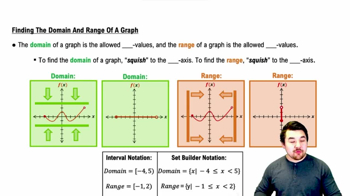
The domain of a function is the set of all possible input values (x-values) for which the function is defined, while the range is the set of all possible output values (y-values). When composing functions, it is important to consider the domain of the inner function and how it affects the overall composition. Understanding domain and range ensures that the composed function is valid and helps avoid undefined expressions.

 1:54 minutes
 Verified step by step guidance
 3:48
3:48