Find the derivative of the following functions. y = In x / (In x + 1)
Verified step by step guidance
1
Step 1: Identify the function y = \( \frac{\ln(x)}{\ln(x) + 1} \). This is a quotient of two functions, so we will use the Quotient Rule to find the derivative.
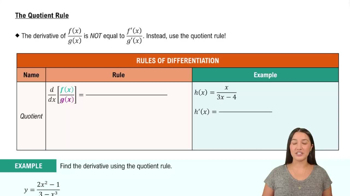
Step 2: Recall the Quotient Rule for derivatives, which states that if you have a function \( y = \frac{u}{v} \), then the derivative \( y' = \frac{u'v - uv'}{v^2} \). Here, \( u = \ln(x) \) and \( v = \ln(x) + 1 \).
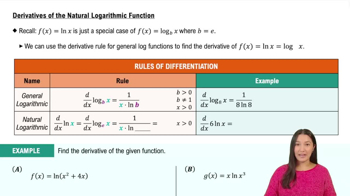
Step 3: Find the derivative of \( u = \ln(x) \). The derivative \( u' = \frac{1}{x} \).
Step 4: Find the derivative of \( v = \ln(x) + 1 \). The derivative \( v' = \frac{1}{x} \) since the derivative of a constant is zero.
Step 5: Substitute \( u' \), \( u \), \( v' \), and \( v \) into the Quotient Rule formula: \( y' = \frac{\left(\frac{1}{x}\right)(\ln(x) + 1) - (\ln(x))\left(\frac{1}{x}\right)}{(\ln(x) + 1)^2} \). Simplify the expression to find the derivative.
Verified video answer for a similar problem:
This video solution was recommended by our tutors as helpful for the problem above
Video duration:
7m
Play a video:
0 Comments
Key Concepts
Here are the essential concepts you must grasp in order to answer the question correctly.
Derivative
The derivative of a function measures how the function's output value changes as its input value changes. It is a fundamental concept in calculus that provides the slope of the tangent line to the curve at any given point. The derivative is often denoted as f'(x) or dy/dx, and it can be calculated using various rules, such as the power rule, product rule, and quotient rule.
The quotient rule is a formula used to find the derivative of a function that is the ratio of two other functions. If you have a function y = u/v, where u and v are both differentiable functions of x, the derivative is given by y' = (v * u' - u * v') / v^2. This rule is essential for differentiating functions where one function is divided by another, as seen in the given problem.
The natural logarithm, denoted as ln(x), is the logarithm to the base e, where e is approximately equal to 2.71828. It is a key function in calculus, particularly in differentiation and integration. The derivative of ln(x) is 1/x, which is crucial when differentiating functions that involve natural logarithms, as in the provided function y = ln(x) / (ln(x) + 1).

 7:05 minutes
 Verified step by step guidance

 05:44
05:44