63–74. Derivatives of logarithmic functions Calculate the derivative of the following functions. In some cases, it is useful to use the properties of logarithms to simplify the functions before computing f'(x).
y = log₈ |tan x|
Verified step by step guidance
1
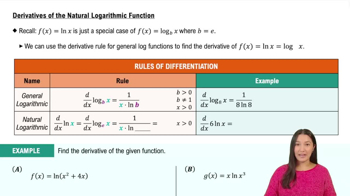
First, recognize that the function y = log₈ |tan x| involves a logarithm with a base other than e or 10. To differentiate this, use the change of base formula: log₈ |tan x| = (log |tan x|) / (log 8).
Next, differentiate the expression (log |tan x|) / (log 8). Since log 8 is a constant, the derivative of y with respect to x is (1 / log 8) times the derivative of log |tan x|.
To differentiate log |tan x|, apply the chain rule. The derivative of log u with respect to u is 1/u, and the derivative of |tan x| with respect to x is the derivative of tan x times the derivative of |u| with respect to u.
The derivative of tan x is sec² x. Therefore, the derivative of |tan x| is sec² x times the sign of tan x, which is tan x / |tan x|.
Combine these results: the derivative of log |tan x| is (1 / |tan x|) * (tan x / |tan x|) * sec² x. Multiply this by (1 / log 8) to find the derivative of y = log₈ |tan x|.
Verified video answer for a similar problem:
This video solution was recommended by our tutors as helpful for the problem above
Video duration:
7m
Play a video:
0 Comments
Key Concepts
Here are the essential concepts you must grasp in order to answer the question correctly.
Logarithmic Functions
Logarithmic functions are the inverses of exponential functions and are defined as y = log_b(x), where b is the base and x is the argument. They have unique properties, such as log_b(xy) = log_b(x) + log_b(y) and log_b(x/y) = log_b(x) - log_b(y), which can simplify complex expressions. Understanding these properties is crucial for manipulating logarithmic expressions before differentiation.
The derivative of a logarithmic function can be computed using the formula d/dx[log_b(u)] = (1/(u ln(b))) * (du/dx), where u is a function of x. This formula highlights the chain rule in differentiation, as it requires finding the derivative of the inner function u. Mastery of this derivative is essential for solving problems involving logarithmic functions.
Understanding the properties of derivatives, such as the product rule, quotient rule, and chain rule, is vital for calculating derivatives of more complex functions. These rules allow for the differentiation of products, quotients, and compositions of functions systematically. Applying these rules correctly is necessary when dealing with functions that involve logarithms and trigonometric expressions, like tan(x) in the given problem.

 7:16 minutes
 Verified step by step guidance
 5:26
5:26