Show that the functions in Exercises 19–26 have exactly one zero in the given interval.
r(θ) = 2θ − cos²θ + √2, (−∞, ∞)
Verified step by step guidance
1
First, understand that finding the zero of a function means finding the value of θ for which r(θ) = 0. We need to show that there is exactly one such value in the interval (−∞, ∞).
Consider the function r(θ) = 2θ − cos²θ + √2. To find the zeros, set the equation to zero: 2θ − cos²θ + √2 = 0.
To determine if there is exactly one zero, analyze the behavior of the function. Start by finding the derivative r'(θ) to understand the function's monotonicity. The derivative is r'(θ) = 2 + 2cos(θ)sin(θ).
Evaluate the derivative r'(θ). Notice that r'(θ) = 2 + sin(2θ), which is always positive because sin(2θ) ranges from -1 to 1, making 2 + sin(2θ) always greater than 0. This indicates that r(θ) is a strictly increasing function.
Since r(θ) is strictly increasing, it can cross the x-axis at most once. Check the limits as θ approaches -∞ and ∞ to ensure the function crosses the x-axis. As θ approaches -∞, r(θ) approaches -∞, and as θ approaches ∞, r(θ) approaches ∞. Therefore, by the Intermediate Value Theorem, there is exactly one zero in the interval (−∞, ∞).
Verified video answer for a similar problem:
This video solution was recommended by our tutors as helpful for the problem above
Video duration:
4m
Play a video:
0 Comments
Key Concepts
Here are the essential concepts you must grasp in order to answer the question correctly.
Intermediate Value Theorem
The Intermediate Value Theorem states that if a continuous function, f(x), takes on different signs at two points, a and b, then it must cross zero at some point between a and b. This theorem is crucial for proving the existence of a root within an interval, as it guarantees that a zero exists if the function changes sign.
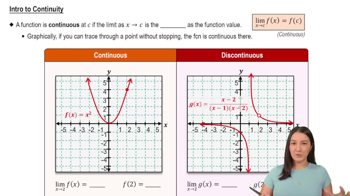
A function is continuous if there are no breaks, jumps, or holes in its graph. For the function r(θ) = 2θ − cos²θ + √2, continuity is essential to apply the Intermediate Value Theorem. Since polynomials, trigonometric functions, and their combinations are continuous over their domains, r(θ) is continuous over (−∞, ∞).
The derivative of a function provides information about its monotonicity, indicating whether the function is increasing or decreasing. By analyzing the derivative of r(θ), we can determine if the function is strictly increasing or decreasing, which helps establish that there is exactly one zero in the interval by showing that the function does not change direction.