Show that the functions in Exercises 19–26 have exactly one zero in the given interval.
g(t) = √t + √(1 + t) − 4, (0, ∞)
Verified step by step guidance
1
First, understand that we need to show the function g(t) = √t + √(1 + t) − 4 has exactly one zero in the interval (0, ∞). This means we need to find where g(t) = 0 and prove it happens only once in the given interval.
To start, evaluate the behavior of g(t) as t approaches 0 and as t approaches infinity. As t approaches 0, g(t) approaches √0 + √1 - 4 = 1 - 4 = -3. As t approaches infinity, both √t and √(1 + t) grow without bound, so g(t) approaches infinity.
Next, check the continuity and differentiability of g(t) in the interval (0, ∞). Since both √t and √(1 + t) are continuous and differentiable for t > 0, g(t) is also continuous and differentiable in (0, ∞).
Apply the Intermediate Value Theorem. Since g(t) is continuous on (0, ∞) and changes from negative to positive as t increases from 0 to infinity, there must be at least one zero in the interval (0, ∞).
To show there is exactly one zero, consider the derivative g'(t) = (1/2√t) + (1/2√(1 + t)). Since both terms are positive for t > 0, g'(t) > 0 for all t in (0, ∞), indicating that g(t) is strictly increasing. Therefore, g(t) can cross the x-axis at most once, confirming exactly one zero in the interval.
Verified video answer for a similar problem:
This video solution was recommended by our tutors as helpful for the problem above
Video duration:
6m
Play a video:
0 Comments
Key Concepts
Here are the essential concepts you must grasp in order to answer the question correctly.
Intermediate Value Theorem
The Intermediate Value Theorem states that if a continuous function, f, takes on values of opposite sign at two points, a and b, then it must have at least one root in the interval (a, b). This concept is crucial for proving the existence of a zero in a given interval by showing that the function changes sign.
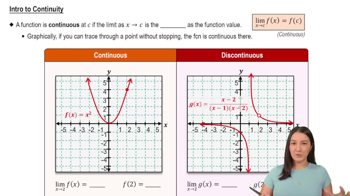
A function is continuous on an interval if it is continuous at every point within that interval. For the function g(t) = √t + √(1 + t) − 4, continuity is essential to apply the Intermediate Value Theorem. The square root functions involved are continuous for t > 0, ensuring g(t) is continuous on (0, ∞).
Understanding how a function behaves as t approaches infinity helps determine the number of zeros. For g(t) = √t + √(1 + t) − 4, as t increases, both √t and √(1 + t) grow, suggesting g(t) will eventually become positive. This behavior, combined with initial negative values, supports the existence of exactly one zero.