Find the slope of the line tangent to the graph of y = sin^−1 x at x=0.
Verified step by step guidance
1
To find the slope of the tangent line to the graph of \( y = \sin^{-1}(x) \) at \( x = 0 \), we need to determine the derivative of \( y \) with respect to \( x \).
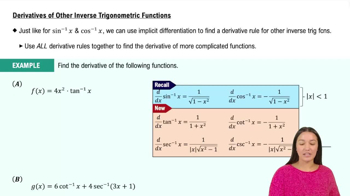
The derivative of \( y = \sin^{-1}(x) \) is given by \( \frac{dy}{dx} = \frac{1}{\sqrt{1-x^2}} \). This formula is derived from the inverse trigonometric function differentiation rules.
Substitute \( x = 0 \) into the derivative \( \frac{dy}{dx} = \frac{1}{\sqrt{1-x^2}} \) to find the slope of the tangent line at this point.
Calculate \( \frac{1}{\sqrt{1-0^2}} \), which simplifies to \( \frac{1}{\sqrt{1}} \).
The slope of the tangent line to the graph of \( y = \sin^{-1}(x) \) at \( x = 0 \) is the value obtained from the previous step.
Verified video answer for a similar problem:
This video solution was recommended by our tutors as helpful for the problem above
Video duration:
1m
Play a video:
0 Comments
Key Concepts
Here are the essential concepts you must grasp in order to answer the question correctly.
Inverse Trigonometric Functions
Inverse trigonometric functions, such as sin^−1(x), are the functions that reverse the action of the standard trigonometric functions. For example, sin^−1(x) gives the angle whose sine is x. Understanding these functions is crucial for evaluating expressions involving them and for finding their derivatives.
Derivatives of Other Inverse Trigonometric Functions
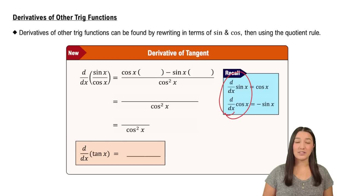
Derivative of a Function
The derivative of a function at a point measures the rate at which the function's value changes as its input changes. It is defined as the limit of the average rate of change as the interval approaches zero. For inverse trigonometric functions, knowing how to compute their derivatives is essential for finding slopes of tangents.
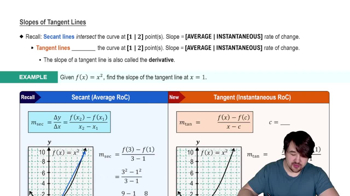
The tangent line to a curve at a given point is the straight line that just touches the curve at that point, representing the instantaneous rate of change of the function at that point. The slope of the tangent line is given by the derivative of the function evaluated at that point, which is critical for solving problems involving tangents.