Determine the convergence or divergence of the series.
Table of contents
- 0. Functions7h 55m
- Introduction to Functions18m
- Piecewise Functions10m
- Properties of Functions9m
- Common Functions1h 8m
- Transformations5m
- Combining Functions27m
- Exponent rules32m
- Exponential Functions28m
- Logarithmic Functions24m
- Properties of Logarithms36m
- Exponential & Logarithmic Equations35m
- Introduction to Trigonometric Functions38m
- Graphs of Trigonometric Functions44m
- Trigonometric Identities47m
- Inverse Trigonometric Functions48m
- 1. Limits and Continuity2h 2m
- 2. Intro to Derivatives1h 33m
- 3. Techniques of Differentiation3h 18m
- 4. Applications of Derivatives2h 38m
- 5. Graphical Applications of Derivatives6h 2m
- 6. Derivatives of Inverse, Exponential, & Logarithmic Functions2h 37m
- 7. Antiderivatives & Indefinite Integrals1h 26m
- 8. Definite Integrals4h 44m
- 9. Graphical Applications of Integrals2h 27m
- 10. Physics Applications of Integrals 3h 16m
- 11. Integrals of Inverse, Exponential, & Logarithmic Functions2h 31m
- 12. Techniques of Integration7h 41m
- 13. Intro to Differential Equations2h 55m
- 14. Sequences & Series5h 36m
- 15. Power Series2h 19m
- 16. Parametric Equations & Polar Coordinates7h 58m
14. Sequences & Series
Convergence Tests
Problem 10.5.3
Textbook Question
What comparison series would you use with the Comparison Test to determine whether
∑ (k = 1 to ∞) 1 / (k² + 1) converges?
Verified step by step guidance1
Identify the given series: \( \sum_{k=1}^{\infty} \frac{1}{k^2 + 1} \). We want to determine if it converges using the Comparison Test.
Recall that for large values of \( k \), the term \( \frac{1}{k^2 + 1} \) behaves similarly to \( \frac{1}{k^2} \) because the \( +1 \) becomes insignificant compared to \( k^2 \).
Choose a comparison series that is simpler but related, such as \( \sum_{k=1}^{\infty} \frac{1}{k^2} \), which is a p-series with \( p = 2 > 1 \) and is known to converge.
Use the Comparison Test by noting that \( \frac{1}{k^2 + 1} < \frac{1}{k^2} \) for all \( k \geq 1 \), so if the larger series \( \sum \frac{1}{k^2} \) converges, then the original series also converges.
Conclude that the appropriate comparison series to use is \( \sum_{k=1}^{\infty} \frac{1}{k^2} \) because it helps establish convergence of the original series by the Comparison Test.
Verified video answer for a similar problem:This video solution was recommended by our tutors as helpful for the problem above
Video duration:
1mPlay a video:
Key Concepts
Here are the essential concepts you must grasp in order to answer the question correctly.
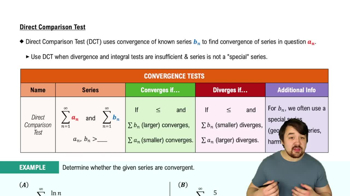
Comparison Test
The Comparison Test determines the convergence or divergence of a series by comparing it to another series with known behavior. If the terms of the given series are smaller than those of a convergent series, it also converges. Conversely, if the terms are larger than those of a divergent series, it diverges.
Recommended video:
Direct Comparison Test
Choice of Comparison Series
To apply the Comparison Test effectively, select a simpler series whose convergence is known and whose terms closely resemble the original series. For ∑ 1/(k² + 1), the series ∑ 1/k² is a natural choice because for large k, 1/(k² + 1) behaves like 1/k².
Recommended video:
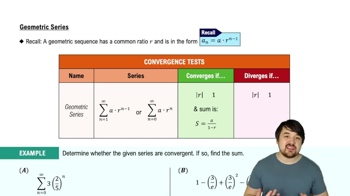
Geometric Series
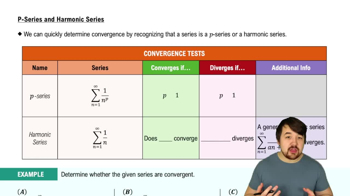
Convergence of p-Series
A p-series ∑ 1/k^p converges if and only if p > 1. Since ∑ 1/k² is a p-series with p = 2, it converges. This fact helps conclude that ∑ 1/(k² + 1) also converges by comparison.
Recommended video:
P-Series and Harmonic Series
Watch next
Master Divergence Test (nth Term Test) with a bite sized video explanation from Patrick
Start learningRelated Videos
Related Practice
Multiple Choice
85
views
1
rank