11–27. Alternating Series Test Determine whether the following series converge. ∑ (k = 0 to ∞) (−1)ᵏ / (2k + 1)
Verified step by step guidance
1
Identify the series given: \( \sum_{k=0}^{\infty} \frac{(-1)^k}{2k+1} \). This is an alternating series because of the factor \( (-1)^k \), which causes the terms to alternate in sign.
Recall the Alternating Series Test (Leibniz Test), which states that an alternating series \( \sum (-1)^k a_k \) converges if two conditions are met: (1) the sequence \( a_k \) is decreasing, and (2) \( \lim_{k \to \infty} a_k = 0 \).
Check the sequence \( a_k = \frac{1}{2k+1} \). First, verify that \( a_k \) is positive and decreasing. Since the denominator \( 2k+1 \) increases as \( k \) increases, \( a_k \) decreases.
Next, evaluate the limit of \( a_k \) as \( k \to \infty \): \( \lim_{k \to \infty} \frac{1}{2k+1} = 0 \). This satisfies the second condition of the Alternating Series Test.
Since both conditions are satisfied, conclude that the series \( \sum_{k=0}^{\infty} \frac{(-1)^k}{2k+1} \) converges by the Alternating Series Test.
Verified video answer for a similar problem:
This video solution was recommended by our tutors as helpful for the problem above
Video duration:
3m
Play a video:
0 Comments
Key Concepts
Here are the essential concepts you must grasp in order to answer the question correctly.
Alternating Series Test
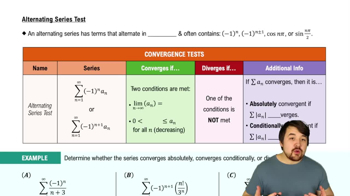
The Alternating Series Test determines the convergence of series whose terms alternate in sign. It requires that the absolute value of the terms decreases monotonically to zero. If these conditions hold, the series converges, though not necessarily absolutely.
A sequence is monotonic decreasing if each term is less than or equal to the previous term. For the Alternating Series Test, the absolute values of the terms must form such a sequence, ensuring the terms get progressively smaller and approach zero.
For a series to converge, the terms must approach zero as the index goes to infinity. This is a necessary condition for convergence; if the terms do not tend to zero, the series diverges regardless of sign alternation.