Determine whether the following statements are true and give an explanation or counterexample. Assume a and L are finite numbers. If limx→a f(x) = L, then f(a)=L.
Verified step by step guidance
1
Step 1: Understand the statement. The statement claims that if the limit of a function \( f(x) \) as \( x \) approaches \( a \) is \( L \), then the function value at \( a \), \( f(a) \), must also be \( L \).
Step 2: Recall the definition of a limit. The limit \( \lim_{x \to a} f(x) = L \) means that as \( x \) gets arbitrarily close to \( a \), \( f(x) \) gets arbitrarily close to \( L \).
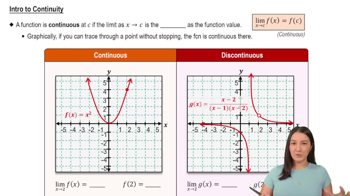
Step 3: Consider the concept of continuity. A function \( f(x) \) is continuous at \( x = a \) if \( \lim_{x \to a} f(x) = f(a) \).
Step 4: Identify a counterexample. Consider the function \( f(x) = \frac{\sin(x)}{x} \) for \( x \neq 0 \) and \( f(0) = 1 \). The limit \( \lim_{x \to 0} \frac{\sin(x)}{x} = 1 \), but \( f(0) = 1 \).
Step 5: Conclude the analysis. The statement is not necessarily true because a function can have a limit at a point without being continuous at that point, meaning \( f(a) \) does not have to equal \( L \).
Verified video answer for a similar problem:
This video solution was recommended by our tutors as helpful for the problem above
Video duration:
3m
Play a video:
0 Comments
Key Concepts
Here are the essential concepts you must grasp in order to answer the question correctly.
Limit of a Function
The limit of a function describes the behavior of the function as the input approaches a certain value. Specifically, limx→a f(x) = L means that as x gets arbitrarily close to a, the values of f(x) approach L. This concept is fundamental in calculus as it helps in understanding continuity and the behavior of functions near specific points.
A function is continuous at a point a if the limit of the function as x approaches a equals the function's value at that point, i.e., limx→a f(x) = f(a). This means there are no breaks, jumps, or holes in the graph of the function at that point. Understanding continuity is crucial for evaluating the truth of the statement regarding limits and function values.
A counterexample is a specific case that disproves a general statement. In the context of limits, if we find a function where limx→a f(x) = L but f(a) ≠ L, it serves as a counterexample to the claim that the limit implies the function's value at that point. This concept is essential for critical thinking and validating mathematical statements.