Determine whether the following statements are true and give an explanation or counterexample. Assume a and L are finite numbers. The limit lim x→a f(x) / g(x) does not exist if g(a)=0.
Verified step by step guidance
1
Step 1: Understand the problem statement. We are given a limit of the form \( \lim_{{x \to a}} \frac{{f(x)}}{{g(x)}} \) and need to determine if it does not exist when \( g(a) = 0 \).
Step 2: Recall the definition of a limit. The limit \( \lim_{{x \to a}} \frac{{f(x)}}{{g(x)}} \) exists if as \( x \) approaches \( a \), the values of \( \frac{{f(x)}}{{g(x)}} \) approach a specific number.
Step 3: Consider the condition \( g(a) = 0 \). This means that directly substituting \( x = a \) into \( \frac{{f(x)}}{{g(x)}} \) results in division by zero, which is undefined.
Step 4: Explore the possibility of the limit existing despite \( g(a) = 0 \). If \( f(x) \) also approaches 0 as \( x \to a \), we have an indeterminate form \( \frac{0}{0} \), which requires further analysis using techniques like L'Hôpital's Rule or algebraic manipulation.
Step 5: Conclude that the statement is not necessarily true. The limit \( \lim_{{x \to a}} \frac{{f(x)}}{{g(x)}} \) may still exist even if \( g(a) = 0 \), depending on the behavior of \( f(x) \) and \( g(x) \) as \( x \to a \).
Verified video answer for a similar problem:

This video solution was recommended by our tutors as helpful for the problem above
Video duration:
4m
Play a video:
0 Comments
Key Concepts
Here are the essential concepts you must grasp in order to answer the question correctly.
Limits
In calculus, a limit describes the behavior of a function as its input approaches a certain value. It is essential for understanding continuity, derivatives, and integrals. The limit can exist even if the function is not defined at that point, which is crucial when evaluating expressions involving division by zero.
Indeterminate forms arise in calculus when evaluating limits that do not lead to a clear value, such as 0/0 or ∞/∞. These forms require further analysis, often using techniques like L'Hôpital's Rule or algebraic manipulation, to determine the actual limit. Recognizing these forms is vital for correctly assessing the behavior of functions near points of discontinuity.
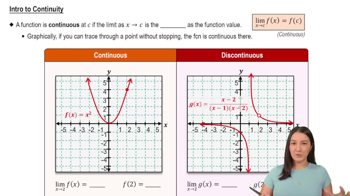
A function is continuous at a point if the limit as the input approaches that point equals the function's value at that point. Discontinuity occurs when this condition is not met, often due to undefined values or jumps in the function. Understanding continuity is key to evaluating limits, especially when dealing with functions that may have points where they are not defined.