11–86. Applying convergence tests Determine whether the following series converge. Justify your answers. ∑ (from k = 1 to ∞)sin(1 / k⁹)
Verified step by step guidance
1
Identify the series given: \( \sum_{k=1}^{\infty} \sin\left(\frac{1}{k^9}\right) \). We want to determine if this series converges.
Recall that for very small angles \( x \), \( \sin x \approx x \). Since \( \frac{1}{k^9} \) becomes very small as \( k \to \infty \), we can approximate \( \sin\left(\frac{1}{k^9}\right) \approx \frac{1}{k^9} \) for large \( k \).
Compare the given series to the p-series \( \sum_{k=1}^{\infty} \frac{1}{k^p} \) where \( p = 9 \). We know that a p-series converges if \( p > 1 \). Since 9 is much greater than 1, the p-series \( \sum \frac{1}{k^9} \) converges.
Use the Limit Comparison Test to justify convergence: compute \( \lim_{k \to \infty} \frac{\sin\left(\frac{1}{k^9}\right)}{\frac{1}{k^9}} \). If this limit is a finite nonzero number, then both series behave similarly in terms of convergence.
Since the limit comparison test shows the given series behaves like a convergent p-series, conclude that \( \sum_{k=1}^{\infty} \sin\left(\frac{1}{k^9}\right) \) converges.
Verified video answer for a similar problem:
This video solution was recommended by our tutors as helpful for the problem above
Video duration:
6m
Play a video:
0 Comments
Key Concepts
Here are the essential concepts you must grasp in order to answer the question correctly.
Convergence of Infinite Series
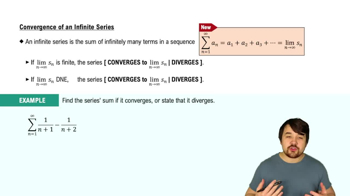
An infinite series converges if the sequence of its partial sums approaches a finite limit. Understanding convergence is essential to determine whether the sum of infinitely many terms results in a finite value or diverges to infinity or oscillates.
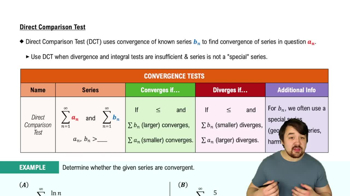
The comparison test involves comparing the given series to a known benchmark series. If the terms of the given series are smaller than those of a convergent series, it also converges; if larger than a divergent series, it diverges. This test helps analyze series with complicated terms.
For values of x close to zero, sin(x) is approximately equal to x. This approximation allows simplification of terms like sin(1/k⁹) to 1/k⁹ for large k, facilitating the use of p-series tests to determine convergence.