11–86. Applying convergence tests Determine whether the following series converge. Justify your answers. ∑ (from k = 1 to ∞)k! / (kᵏ + 3)
Verified step by step guidance
1
First, write down the general term of the series: \(a_k = \frac{k!}{k^k + 3}\).
To determine convergence, consider the behavior of \(a_k\) as \(k\) approaches infinity. Since \(k^k\) grows very rapidly, compare the growth rates of the numerator \(k!\) and the denominator \(k^k\).
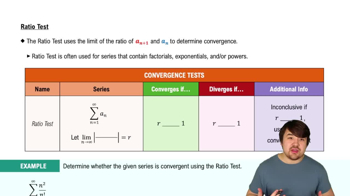
Use the Ratio Test, which involves computing the limit \(L = \lim_{k \to \infty} \left| \frac{a_{k+1}}{a_k} \right|\). Substitute \(a_k\) and simplify the expression:
Simplify the factorial and powers, then evaluate the limit \(L\). If \(L < 1\), the series converges absolutely; if \(L > 1\), it diverges; if \(L = 1\), the test is inconclusive and another test should be applied.
Verified video answer for a similar problem:
This video solution was recommended by our tutors as helpful for the problem above
Video duration:
7m
Play a video:
0 Comments
Key Concepts
Here are the essential concepts you must grasp in order to answer the question correctly.
Convergence of Infinite Series
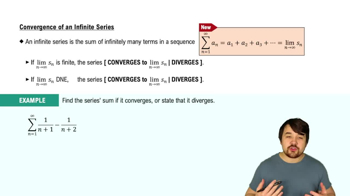
An infinite series converges if the sequence of its partial sums approaches a finite limit. Determining convergence involves analyzing the behavior of the terms as the index grows large, ensuring the sum does not diverge to infinity or oscillate indefinitely.
The Ratio Test evaluates the limit of the absolute value of the ratio of consecutive terms. If this limit is less than one, the series converges absolutely; if greater than one, it diverges. This test is especially useful for series involving factorials and exponential terms.
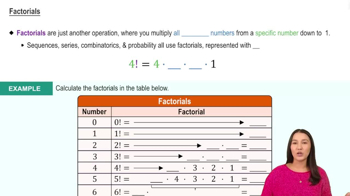
Factorials (k!) grow faster than exponential functions like k^k for large k, but comparing their growth rates helps determine term behavior. Understanding how factorials compare to powers and exponentials is crucial for applying convergence tests effectively.