Function defined by an integral Let ƒ(𝓍) = ∫₀ˣ (t ― 1)¹⁵ (t―2)⁹ dt . (c) For what values of 𝓍 does ƒ have local minima? Local maxima?
Verified step by step guidance
1
Step 1: Recall that to find local minima and maxima of a function, we need to analyze its derivative. The Fundamental Theorem of Calculus tells us that the derivative of ƒ(𝓍) = ∫₀ˣ g(t) dt is ƒ'(𝓍) = g(𝓍). Here, g(t) = (t - 1)¹⁵ (t - 2)⁹.
Step 2: Set ƒ'(𝓍) = g(𝓍) = (𝓍 - 1)¹⁵ (𝓍 - 2)⁹ equal to zero to find critical points. This equation is satisfied when either (𝓍 - 1) = 0 or (𝓍 - 2) = 0. Thus, the critical points are 𝓍 = 1 and 𝓍 = 2.
Step 3: To determine whether these critical points correspond to local minima or maxima, analyze the sign changes of ƒ'(𝓍) = (𝓍 - 1)¹⁵ (𝓍 - 2)⁹ around the critical points. Consider intervals around 𝓍 = 1 and 𝓍 = 2, such as (0, 1), (1, 2), and (2, ∞).
Step 4: Evaluate the behavior of ƒ'(𝓍) in each interval. For example, in the interval (0, 1), both (𝓍 - 1)¹⁵ and (𝓍 - 2)⁹ are negative, making ƒ'(𝓍) positive. In the interval (1, 2), (𝓍 - 1)¹⁵ is positive and (𝓍 - 2)⁹ is negative, making ƒ'(𝓍) negative. In the interval (2, ∞), both terms are positive, making ƒ'(𝓍) positive.
Step 5: Based on the sign changes of ƒ'(𝓍), conclude that 𝓍 = 1 is a local maximum (since ƒ'(𝓍) changes from positive to negative) and 𝓍 = 2 is a local minimum (since ƒ'(𝓍) changes from negative to positive).
Verified video answer for a similar problem:
This video solution was recommended by our tutors as helpful for the problem above
Video duration:
6m
Play a video:
0 Comments
Key Concepts
Here are the essential concepts you must grasp in order to answer the question correctly.
Fundamental Theorem of Calculus
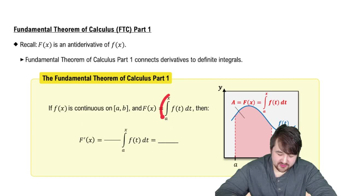
The Fundamental Theorem of Calculus links the concept of differentiation and integration, stating that if a function is defined as an integral, its derivative can be found by evaluating the integrand at the upper limit of integration. This theorem is essential for analyzing the behavior of the function ƒ(𝓍) in the given question.
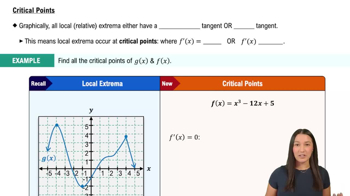
Critical points occur where the derivative of a function is zero or undefined. These points are crucial for determining local maxima and minima, as they represent potential locations where the function's behavior changes. In the context of ƒ(𝓍), finding where the derivative equals zero will help identify these critical points.
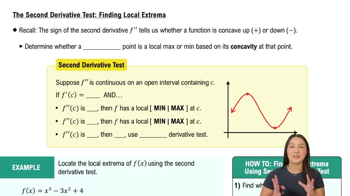
The Second Derivative Test is a method used to classify critical points as local minima, local maxima, or saddle points. By evaluating the second derivative at a critical point, one can determine the concavity of the function at that point. If the second derivative is positive, the point is a local minimum; if negative, it is a local maximum.

 6:50 minutes
 Verified step by step guidance
 06:11
06:11