Area of region Find the area of the region bounded by y = sech x, x = 1, and the unit circle (see figure).
Verified step by step guidance
1
Identify the region bounded by the curve \(y = \text{sech}\,x\), the vertical line \(x = 1\), and the unit circle defined by \(x^2 + y^2 = 1\). The shaded area lies between the circle and the curve from \(x = 0\) to \(x = 1\).
Express the upper boundary of the region on the interval \([0,1]\). The circle's upper half is given by \(y = \sqrt{1 - x^2}\), and the curve is \(y = \text{sech}\,x\). Since the shaded region is between these two curves, the area can be found by integrating the difference of these functions.
Set up the integral for the area \(A\) as the integral from \(x=0\) to \(x=1\) of the difference between the circle's upper half and the \(\text{sech}\,x\) curve:
\(A = \int_0^1 \left( \sqrt{1 - x^2} - \text{sech}\,x \right) \, dx\)
Recall that \(\text{sech}\,x = \frac{1}{\cosh x}\), which is a standard hyperbolic function. This integral may not have a simple closed form, so it might require numerical methods or approximation techniques to evaluate.
Evaluate the integral (using numerical methods if necessary) to find the area of the shaded region bounded by the given curves and line.
Verified video answer for a similar problem:
This video solution was recommended by our tutors as helpful for the problem above
Video duration:
5m
Play a video:
0 Comments
Key Concepts
Here are the essential concepts you must grasp in order to answer the question correctly.
Definite Integrals for Area Calculation
Definite integrals are used to calculate the area under a curve between two points. When finding the area between two curves, the integral of the difference of the functions over the interval gives the enclosed area. This concept is essential for determining the region bounded by y = sech x, the unit circle, and the vertical line x = 1.
The hyperbolic secant function, sech x, is defined as 1/cosh x, where cosh x is the hyperbolic cosine. It is a smooth, positive function that decreases symmetrically from 1 at x=0. Understanding its behavior helps in setting up the integral limits and comparing it with the unit circle curve.
The unit circle is defined by x² + y² = 1, representing all points at a distance 1 from the origin. Solving for y gives y = ±√(1 - x²), which describes the upper and lower semicircles. This geometric understanding is crucial to identify the boundary curve and the region enclosed with y = sech x and x = 1.

 5:28 minutes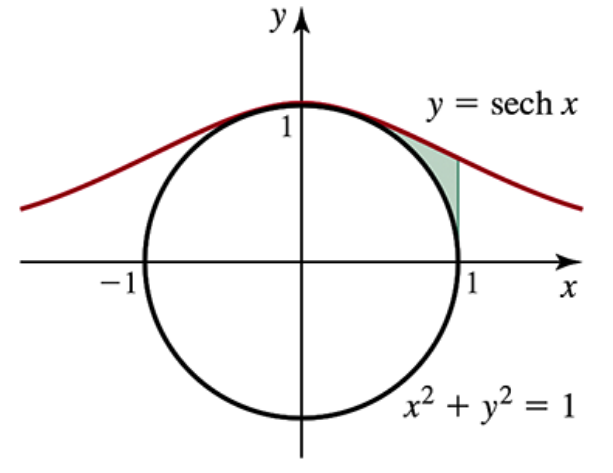
 Verified step by step guidance

 05:43
05:43