Solid of revolution Compute the volume of the solid of revolution that results when the region in Exercise 85 is revolved about the x-axis.
Verified step by step guidance
1
Identify the region described in Exercise 85. This region will be bounded by certain curves or lines, which you need to clearly define in terms of functions of x (or y).
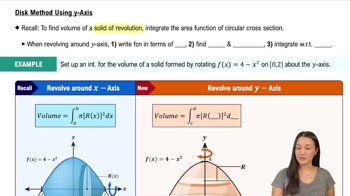
Set up the integral for the volume of the solid of revolution using the disk or washer method, since the solid is revolved about the x-axis. The general formula for volume is \(V = \pi \int_a^b [R(x)]^2 \, dx\), where \(R(x)\) is the radius of the disk at position \(x\).
Determine the radius function \(R(x)\), which is the distance from the x-axis to the curve defining the boundary of the region. If there are two curves, use the difference of their squares to form the washer method: \(V = \pi \int_a^b \left([R_{outer}(x)]^2 - [R_{inner}(x)]^2\right) \, dx\).
Find the limits of integration \(a\) and \(b\) by identifying the interval over which the region extends along the x-axis.
Write the definite integral with the correct limits and radius functions, then prepare to evaluate or simplify the integral to find the volume.
Verified video answer for a similar problem:
This video solution was recommended by our tutors as helpful for the problem above
Video duration:
6m
Play a video:
0 Comments
Key Concepts
Here are the essential concepts you must grasp in order to answer the question correctly.
Solid of Revolution
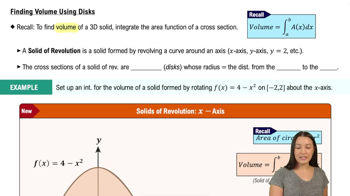
A solid of revolution is a three-dimensional object created by rotating a two-dimensional region around an axis. This process generates a volume whose cross-sections are circular disks or washers, depending on the shape of the region and the axis of rotation.
These methods are techniques to find the volume of solids of revolution. The disk method uses circular cross-sections perpendicular to the axis of rotation, while the washer method accounts for hollow regions by subtracting inner radii from outer radii, forming washers.
Volumes of solids of revolution are computed using definite integrals that sum the volumes of infinitesimally thin disks or washers. The integral limits correspond to the interval over which the region extends along the axis of rotation.

 6:26 minutes
 Verified step by step guidance
 04:48
04:48