23-64. Integration Evaluate the following integrals. 26. ∫₀¹ [1 / (t² - 9)] dt
Verified step by step guidance
1
Identify the integral to be evaluated: \(\int_0^1 \frac{1}{t^2 - 9} \, dt\).
Recognize that the denominator can be factored using the difference of squares: \(t^2 - 9 = (t - 3)(t + 3)\).
Use partial fraction decomposition to express \(\frac{1}{t^2 - 9}\) as \(\frac{A}{t - 3} + \frac{B}{t + 3}\), and solve for constants \(A\) and \(B\).
Rewrite the integral as the sum of two simpler integrals: \(\int_0^1 \frac{A}{t - 3} \, dt + \int_0^1 \frac{B}{t + 3} \, dt\).
Integrate each term separately using the natural logarithm function: \(\int \frac{1}{t - a} \, dt = \ln|t - a| + C\), then apply the limits from 0 to 1.
Verified video answer for a similar problem:
This video solution was recommended by our tutors as helpful for the problem above
Video duration:
6m
Play a video:
0 Comments
Key Concepts
Here are the essential concepts you must grasp in order to answer the question correctly.
Improper Integrals
An improper integral occurs when the integrand is undefined or unbounded within the interval of integration. In this problem, the denominator t² - 9 equals zero at t = ±3, which lies outside the interval [0,1], so the integral is proper. However, understanding improper integrals helps in evaluating integrals with singularities.
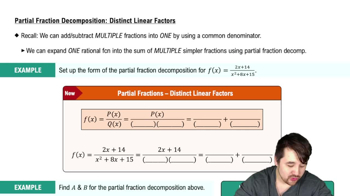
Partial fraction decomposition breaks a rational function into simpler fractions that are easier to integrate. For the integrand 1/(t² - 9), factor the denominator as (t - 3)(t + 3) and express the fraction as a sum of terms with linear denominators, facilitating straightforward integration.
Partial Fraction Decomposition: Distinct Linear Factors
Definite Integration Techniques
Definite integration involves finding the exact area under a curve between two limits. After decomposing the integrand, integrate each term separately and then apply the Fundamental Theorem of Calculus by evaluating the antiderivative at the upper and lower limits to find the integral's value.