63–68. Definite integrals Evaluate the following definite integrals. Use Theorem 7.7 to express your answer in terms of logarithms. ∫₋₂² dt/(t² – 9)
Verified step by step guidance
1
Identify the integral to evaluate: \(\displaystyle \int_{-2}^{2} \frac{dt}{t^{2} - 9}\).
Recognize that the denominator can be factored using the difference of squares: \(t^{2} - 9 = (t - 3)(t + 3)\).
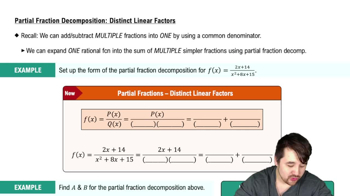
Set up the partial fraction decomposition: \(\frac{1}{t^{2} - 9} = \frac{A}{t - 3} + \frac{B}{t + 3}\), and solve for constants \(A\) and \(B\).
Rewrite the integral as the sum of two integrals involving \(\frac{1}{t - 3}\) and \(\frac{1}{t + 3}\), then integrate each term separately to get expressions involving logarithms.
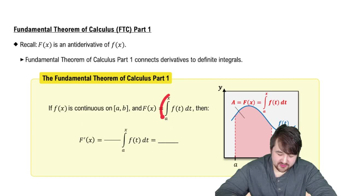
Apply the Fundamental Theorem of Calculus (Theorem 7.7) by evaluating the antiderivative at the upper limit \(2\) and the lower limit \(-2\), then subtract to find the definite integral.
Verified video answer for a similar problem:
This video solution was recommended by our tutors as helpful for the problem above
Video duration:
5m
Play a video:
0 Comments
Key Concepts
Here are the essential concepts you must grasp in order to answer the question correctly.
Definite Integrals
A definite integral calculates the net area under a curve between two limits. It is represented as ∫_a^b f(t) dt, where a and b are the bounds. Evaluating definite integrals often involves finding an antiderivative and then applying the Fundamental Theorem of Calculus.
Partial fraction decomposition breaks a rational function into simpler fractions that are easier to integrate. For integrals involving rational functions like 1/(t² - 9), this method helps rewrite the integrand into terms whose antiderivatives are known, such as logarithmic functions.
Partial Fraction Decomposition: Distinct Linear Factors
Logarithmic Integration and Theorem 7.7
Theorem 7.7 typically refers to the integral of 1/(x - a) being ln|x - a| + C. When integrating rational functions that factor into linear terms, the antiderivative often involves logarithms. Expressing the answer in terms of logarithms means using this theorem to write the integral in a simplified logarithmic form.

 5:45 minutes
 Verified step by step guidance

 05:43
05:43