Find the derivatives of the functions in Exercises 19–40.
y = (5 − 2x)⁻³ + (1 / 8)(2 / x + 1)⁴
Verified step by step guidance
1
Step 1: Identify the structure of the function. The given function is y = (5 − 2x)−3 + (1/8)(2/x + 1)4. It consists of two terms: the first term is a power function, and the second term is a composite function involving a constant multiplier and a power of a rational expression.
Step 2: Differentiate the first term, (5 − 2x)−3, using the chain rule. Let u = (5 − 2x). Then, the derivative of u−3 is −3u−4 multiplied by the derivative of u, which is −2. Combine these results to find the derivative of the first term.
Step 3: Differentiate the second term, (1/8)(2/x + 1)4, using the chain rule. First, treat (1/8) as a constant multiplier. Let v = (2/x + 1). The derivative of v4 is 4v3 multiplied by the derivative of v. To find the derivative of v, rewrite 2/x as 2x−1 and differentiate it.
Step 4: Combine the results from Steps 2 and 3. Add the derivatives of the two terms together to form the derivative of the entire function y.
Step 5: Simplify the expression for the derivative by combining like terms and ensuring the result is in its simplest form. This may involve rewriting negative exponents or rational expressions for clarity.
Verified video answer for a similar problem:
This video solution was recommended by our tutors as helpful for the problem above
Video duration:
4m
Play a video:
0 Comments
Key Concepts
Here are the essential concepts you must grasp in order to answer the question correctly.
Derivative
The derivative of a function measures how the function's output value changes as its input value changes. It is a fundamental concept in calculus, representing the slope of the tangent line to the curve of the function at any given point. The derivative can be computed using various rules, such as the power rule, product rule, and chain rule.
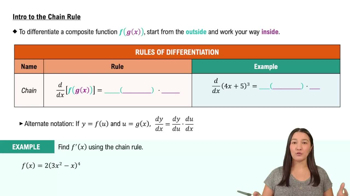
The chain rule is a formula for computing the derivative of the composition of two or more functions. It states that if you have a function that is the composition of two functions, the derivative can be found by multiplying the derivative of the outer function by the derivative of the inner function. This is particularly useful when dealing with functions raised to a power or nested functions.
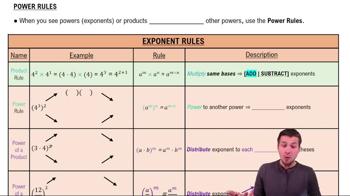
The power rule is a basic rule for finding the derivative of a function in the form of f(x) = x^n, where n is a real number. According to this rule, the derivative f'(x) is given by n*x^(n-1). This rule simplifies the process of differentiation for polynomial functions and is essential for handling terms in the given function.