Ch. 8 - Techniques of Integration
Hass - Thomas' Calculus 15th Edition
Hass15th EditionThomas' CalculusISBN: 9780137616077Not the one you use?Change textbook
Chapter 8, Problem 8.1.54c

Using different substitutions
Show that the integral
∫((x² - 1)(x + 1))^(-2/3) dx
can be evaluated with any of the following substitutions.
c. u = arctan x
What is the value of the integral?

Verified step by step guidance
1
Start with the integral \( \int ((x^{2} - 1)(x + 1))^{-\frac{2}{3}} \, dx \). First, simplify the expression inside the integral if possible. Notice that \( (x^{2} - 1)(x + 1) = (x - 1)(x + 1)(x + 1) = (x - 1)(x + 1)^{2} \). So the integral becomes \( \int \left( (x - 1)(x + 1)^{2} \right)^{-\frac{2}{3}} \, dx \).
Apply the substitution \( u = \arctan x \). Then, differentiate both sides to find \( du \) in terms of \( dx \): \( du = \frac{1}{1 + x^{2}} \, dx \), which implies \( dx = (1 + x^{2}) \, du \).
Express the integral entirely in terms of \( u \). Since \( x = \tan u \), rewrite all parts of the integrand: \( x - 1 = \tan u - 1 \), \( x + 1 = \tan u + 1 \), and \( dx = (1 + \tan^{2} u) \, du = \sec^{2} u \, du \). Substitute these into the integral.
Rewrite the integral as \( \int \left( (\tan u - 1)(\tan u + 1)^{2} \right)^{-\frac{2}{3}} \sec^{2} u \, du \). Simplify the expression inside the parentheses if possible, and then simplify the powers and factors to get the integral in terms of \( u \) only.
Once the integral is expressed in terms of \( u \), proceed to integrate with respect to \( u \). After finding the antiderivative, substitute back \( u = \arctan x \) to express the answer in terms of \( x \).

Verified video answer for a similar problem:

This video solution was recommended by our tutors as helpful for the problem above.
Video duration:
7m
Was this helpful?

Key Concepts

Here are the essential concepts you must grasp in order to answer the question correctly.

Integration by Substitution

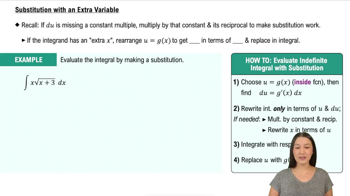
Integration by substitution is a method to simplify integrals by changing variables. It involves choosing a new variable u = g(x) to rewrite the integral in terms of u, making it easier to evaluate. The derivative du/dx replaces dx, and the integral limits or integrand are adjusted accordingly.
Recommended video:
04:27
Substitution With an Extra Variable

Trigonometric Substitution

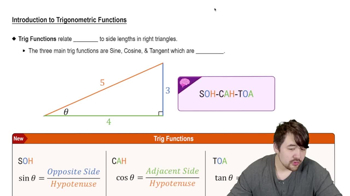
Trigonometric substitution replaces algebraic expressions with trigonometric functions to simplify integrals involving roots or powers. For example, using u = arctan(x) transforms expressions involving x into functions of u, leveraging identities like 1 + tan²u = sec²u to simplify the integrand.
Recommended video:
6:04
Introduction to Trigonometric Functions

Evaluating Integrals with Inverse Trigonometric Functions

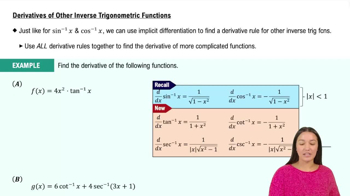
When the substitution involves inverse trigonometric functions, the integral is expressed in terms of u = arctan(x). This requires rewriting x and dx in terms of u and using trigonometric identities to simplify the integrand before integrating, often resulting in expressions involving trigonometric or algebraic functions of u.
Recommended video:
06:35
Derivatives of Other Inverse Trigonometric Functions
Related Practice
Textbook Question

Finding area

Find the area of the region enclosed by the curve y = x sin(x) and the x-axis (see the accompanying figure) for:

c. 2π ≤ x ≤ 3π.

44
views

Textbook Question

89. Consider the infinite region in the first quadrant bounded by the graphs of

y = 1 / x², y = 0, and x = 1.

b. Find the volume of the solid formed by revolving the region (ii) about the y-axis.

19
views
Textbook Question

The instructions for the integrals in Exercises 1–10 have three parts, one for the Midpoint Rule, one for the Trapezoidal Rule, and one for Simpson’s Rule.

II. Using the Trapezoidal Rule

a. Estimate the integral with n = 4 steps and find an upper bound for |ET|.

∫ from 0 to π of sin(t) dth

16
views
Textbook Question

The instructions for the integrals in Exercises 1–10 have three parts, one for the Midpoint Rule, one for the Trapezoidal Rule, and one for Simpson’s Rule.

II. Using the Trapezoidal Rule

a. Estimate the integral with n = 4 steps and find an upper bound for |ET|.

∫ from -2 to 0 of (x² - 1) dx

23
views
Textbook Question

90. Consider the infinite region in the first quadrant bounded by the graphs of

y = 1 / √x, y = 0, x = 0, and x = 1.

b. Find the volume of the solid formed by revolving the region (ii) about the y-axis.

25
views
Textbook Question

The instructions for the integrals in Exercises 1–10 have three parts, one for the Midpoint Rule, one for the Trapezoidal Rule, and one for Simpson’s Rule.

II. Using the Trapezoidal Rule

a. Estimate the integral with n = 4 steps and find an upper bound for |ET|.

∫ from 1 to 2 of 1 / s² ds

16
views